Redefining Insurable Risk in the Grey Zone
From Episodic Shock to Ambient Hostility
Risk in insurance terms has long depended on temporal definition. Perils are triggered, quantified, and priced on the basis of when something begins, how long it lasts, and what stops it. In conflict environments, this has historically aligned with declarations of war, identifiable attacks, or attributable acts of terrorism. The Grey Zone undermines that architecture.
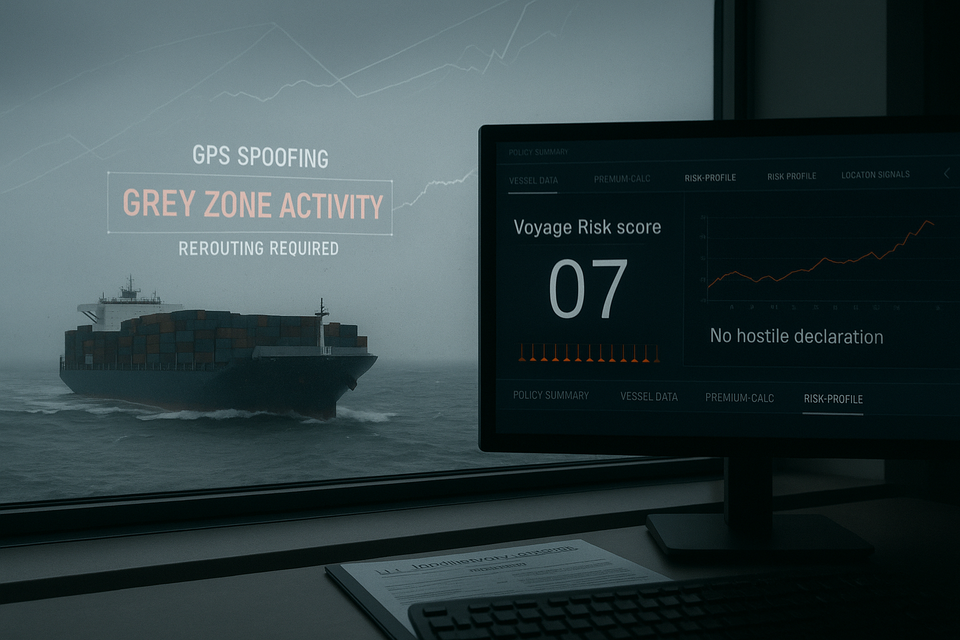
From the Baltic Sea to the Red Sea, 2025 has seen a steady pattern emerge: state-aligned interference sustained over months, often at levels just below conventional retaliation thresholds. GPS jamming reported near Kaliningrad in June was not framed as a singular breach, but as a signal of continuity. Lithuanian authorities described it as the new baseline, an environment of “persistent electronic interference” likely to outlast the Ukraine conflict itself.
What’s being contested is no longer territory, but access, continuity, and reliability. This shift is doctrinally aligned with what Chinese and Russian military theorists have long explored as “information dominance” and “reflexive control”, concepts designed to shape, delay, or misdirect decision-making through ambient disruption rather than overt kinetic force.
In this context, the traditional episodic model of insurable war or terror becomes not only incomplete but strategically mismatched. What underwriters are increasingly exposed to is not a moment of impact, but a climate of deliberate friction.
2. Civilian Infrastructure as a Deliberate Battleground
In conventional frameworks, risk is calculated on the assumption that war is exceptional, terrorism is opportunistic, and infrastructure is collateral. Grey Zone activity subverts each of those assumptions.
In April, U.S. forces conducted coordinated strikes on the Ras Isa oil terminal in Yemen. Though declared as a response to specific Houthi actions, the operational effect was the disabling of a critical node in the region’s energy transit system, a site previously regarded as commercial rather than contested. In parallel, Operation Rough Rider (March–May 2025) targeted a wider array of maritime and land assets associated with shipping disruption. Yet the actors were not state forces in uniform, and the targeting rationale was not a conventional military threat, but the pattern of persistent interference.
What has shifted is not just the use of force, but the theatre in which force operates. Maritime logistics corridors, satellite constellations, signal towers and commercial ports now function simultaneously as economic enablers and military pressure points.
This recalibration is not accidental. It reflects a strategic recognition, particularly in adversary doctrine, that disrupting supply chains or degrading navigational trust can yield greater leverage than direct confrontation. The insurance implications are profound. Policies that exclude coverage on the basis of overt war or attributable terrorism now encounter scenarios that meet neither test, yet result in systemic loss.
3. Attribution, Intention, and the Failure of Binary Clauses
At the centre of today’s coverage frameworks lie binary assumptions: that events are either insurable or not; that actors are state or non-state; that causes are cyber, kinetic, or terror, but never layered. Grey Zone realities steadily dissolve these distinctions.
In May, the U.S. reached a ceasefire agreement with Houthi forces that suspended attacks on American-linked vessels. However, that same agreement explicitly preserved their right to continue targeting Israeli-affiliated shipping. This was not a cessation of hostility, but a partial recalibration of it, threat modulation rather than termination.
Similarly, the use of spoofed vessel identities in the Strait of Hormuz, including ships falsely broadcasting “China-owned” signals, reflected a conscious attempt by commercial operators to reroute perceived threat without legal clarity or formal protection.
The difficulty for insurers lies not in pricing volatility but in defining intent. Clause structures built around state versus non-state dichotomies, or reliant on national declarations to trigger war coverage, no longer map cleanly to operational reality.
This is where adversary doctrine again casts light. Both Russian and Chinese concepts of escalation privilege ambiguity. Whether through plausible deniability, decentralised proxies, or cognitive interference, the intent is often to keep insurance mechanisms, along with legal frameworks and military alliances, in suspension.
4. Market Response as Strategic Signal
When Frontline, one of the world’s largest tanker operators, paused new contracts through the Strait of Hormuz due to deteriorating security, the message was not simply commercial. It was declarative: the security guarantees once presumed in international corridors could no longer be relied upon, and the insurance market could no longer absorb that gap.
War-risk premiums across Red Sea lanes have remained elevated since early 2025. At points, cover has reached 2% of hull value for vessels deemed high profile, not because of a formal escalation, but due to accumulated signals, selective targeting, and digital spoofing.
These shifts reflect a tacit recognition that conventional coverage assumptions, particularly around declared hostilities or generalised exclusions, are structurally incompatible with the fluidity of the current environment.
Equally notable is the legal uncertainty emerging from cyber-related precedent. Legal briefings in January highlighted ongoing disputes around whether acts like NotPetya, widely believed to be state-linked, should fall under war exclusions when no war has been formally acknowledged. The financial system’s exposure to logic-based aggression, absent kinetic triggers, remains unresolved.
5. Toward a New Model: Persistent Hostile Activity as a Peril
The emerging pattern calls for a distinct framing: one that views persistent hostile activity (PHA) not as an interpretative challenge but as an insurable condition in its own right.
This does not imply the abandonment of conventional categories, war, cyber, terrorism, but the addition of a fourth vector that reflects today’s operational reality. A “PHA clause” would recognise specific indicators: unattributed jamming, declared ceasefire-exemptions, hybrid kinetic attacks on non-military assets, and adversarial deception in commercial contexts.
Trigger mechanisms might include:
- Continuity of interference over a defined period (e.g. >14 days).
- State-origin indicators (e.g. GPS jamming geolocation, spoofing infrastructure).
- Strategic declarations by insured governments (e.g. Lithuanian MOD warning of ongoing aggression.
- Changes in commercial behaviour (e.g. operator withdrawal, flagged AIS anomalies).
These would permit more calibrated underwriting. Pricing could reflect exposure to contested corridors without relying on political declarations or legal findings. Loss models could begin to incorporate threat persistence, actor modulation, and exposure to spoofed narrative manipulation.
6. Regulatory Alignment and the Path Forward
To operationalise this shift, alignment is required across regulatory, supervisory, and reinsurance frameworks. The Prudential Regulation Authority (PRA) already mandates impact tolerance planning under SS1/21. Yet that tolerance depends on knowing which shocks are modellable. PHA does not behave like a shock. It behaves like a pressure system.
Ratings agencies may also need to re-express their capital adequacy models. Reinsurers must consider how to pool persistent rather than probabilistic risk. In parallel, the Lloyd’s market, which pioneered the cyber war exclusions framework (LMA3100), is well positioned to trial a Persistent Hostile Activity clause suite across cyber, marine, and terrorism portfolios.
No model will fully eliminate ambiguity. But the goal is not total certainty, it is functional alignment between what is happening and what is covered. That means moving from an exclusion-based framework to an exposure-based one. One that recognises the spectrum between war and peace not as a grey area to be avoided, but as the operating environment to be understood and insured.
🔗 Read The Full White Paper Here 👉 https://ambient-stratagem.ghost.io/content/files/2025/06/Redefining-Insurable-Risk-in-the-Grey-Zone.pdf