
No Human in the Loop – 26th April 2025

Dispatches from the Algorithmic Front
19th - 25th April 2025
Introduction
Some weeks, it’s the silence between the signals that’s most revealing. The machines didn’t scream, but they’ve certainly stirred: NATO’s still clinging to American code, Russia’s tightening its grip through shadowy hybrid assaults, and the AI deception game just stepped into its Hannibal Lecter phase—elegant, chilling, and entirely algorithmic. Meanwhile, someone at Interpol seems to be collecting cyberpunk kit like it’s going out of fashion.
As always, the war-fighting logic is shifting faster than the legal frameworks meant to contain it. But if there’s one consistent theme from this week: trust no input unless you know who’s spoofing it.
Top AI, War, and Cyber Events of the Week
1. AI Deception Now an Official Military Discipline
The U.S. Army is openly discussing how to fool enemy AI systems in the same way it’s always sought to mislead enemy commanders. In a paper published by military officers Mark Askew and Antonio Salinas, deception doctrine is being updated for the machine age: the new targets aren’t just radar operators or battlefield commanders, but the algorithms interpreting ISR feeds. Misinform the AI, and you misdirect the missile. The future of warfare might just be a masterclass in lying to computers.
2. Dutch Intelligence Warns of Russian Hybrid Operations Escalating in Europe
The Netherlands’ military intelligence service (MIVD) confirmed that Russia has ramped up hybrid attacks across Europe, including a thwarted sabotage attempt on Dutch infrastructure. Critical energy networks, undersea cables, and public services are now targets. Chinese actors were also accused of extensive cyber espionage, especially in relation to the Dutch semiconductor industry. The message from The Hague: European complacency is Russia’s best friend.
3. AI Data Centres Under Siege by Espionage and Design Flaws
A blistering report by Gladstone AI, commissioned for review by the Trump administration, claims that America’s AI data centres are “highly vulnerable” to espionage and low-cost sabotage. Many core components are still sourced from China, creating a strategic backdoor for disruption. The report also raised the spectre of AI systems demonstrating autonomous behaviours—fuel for the long-standing debate around superintelligence control. Even OpenAI’s much-hyped “Stargate” project didn’t escape critique.
4. Interpol’s Singapore Lab Is Now a Sci-Fi Crimefighting Hub
It’s not often Interpol makes this newsletter, but here we are: their Singapore-based innovation centre has become a crime-fighting theme park. It features underwater drones, forensic labs that analyse damaged devices in Faraday cages, and yes—robotic K9 units. The lab supports operations across 196 countries and is placing a particular focus on countering AI-powered scams, deepfakes, and 3D-printed weaponry. A 1920s policing agency now firmly playing in the 2020s tech league.
How These Events Connect (or Don’t)
What links these developments is the shifting definition of control—who has it, how it’s exercised, and whether we can ever be sure it’s real.
- Military deception for AI is not just a technical challenge; it’s a philosophical one. We’ve trained machines to find patterns faster than any human—but now we must actively mislead them without tripping over our own.
- The Russian and Chinese hybrid threats show how vulnerability isn’t just about firewalls—it’s about societal trust, political cohesion, and physical chokepoints. This is infrastructure warfare by other means.
- Interpol’s transformation, while a counter-crime initiative, mirrors military trends: high-tempo, data-rich environments requiring autonomous and semi-autonomous decision loops to stay ahead.
- And the Gladstone AI report? A stark reminder that we’re building critical digital infrastructure on foundations we don’t fully control—while our adversaries understand that perfectly.
This week’s events don’t form a neat arc. Instead, they resemble a scatter plot of converging risks—each requiring a different kind of resilience, and none of them waiting for legislation to catch up.
Predictions for the Month Ahead
- Expect AI counter-deception research to spike—especially within NATO and Five Eyes cyber commands. If we’re building systems to be faster than humans, we now need them to be sceptical, too.
- European data centre sovereignty will be back in the spotlight, particularly around secure training and inference environments for defence-grade models. Politicians will promise investment; implementation will lag.
- Hybrid warfare thresholds will lower. With Russia emboldened and the West distracted, expect more “grey zone” tactics—cable tapping, GPS spoofing, low-deniability cyber acts—just shy of formal escalation.
- Interpol’s model will go viral. Other multilateral security organisations (think Europol, ASEAN Defence Ministers’ Meeting-Plus) may replicate its fusion of AI, robotics, and shared intelligence, especially for transnational threats.
Fun Fact of the Week
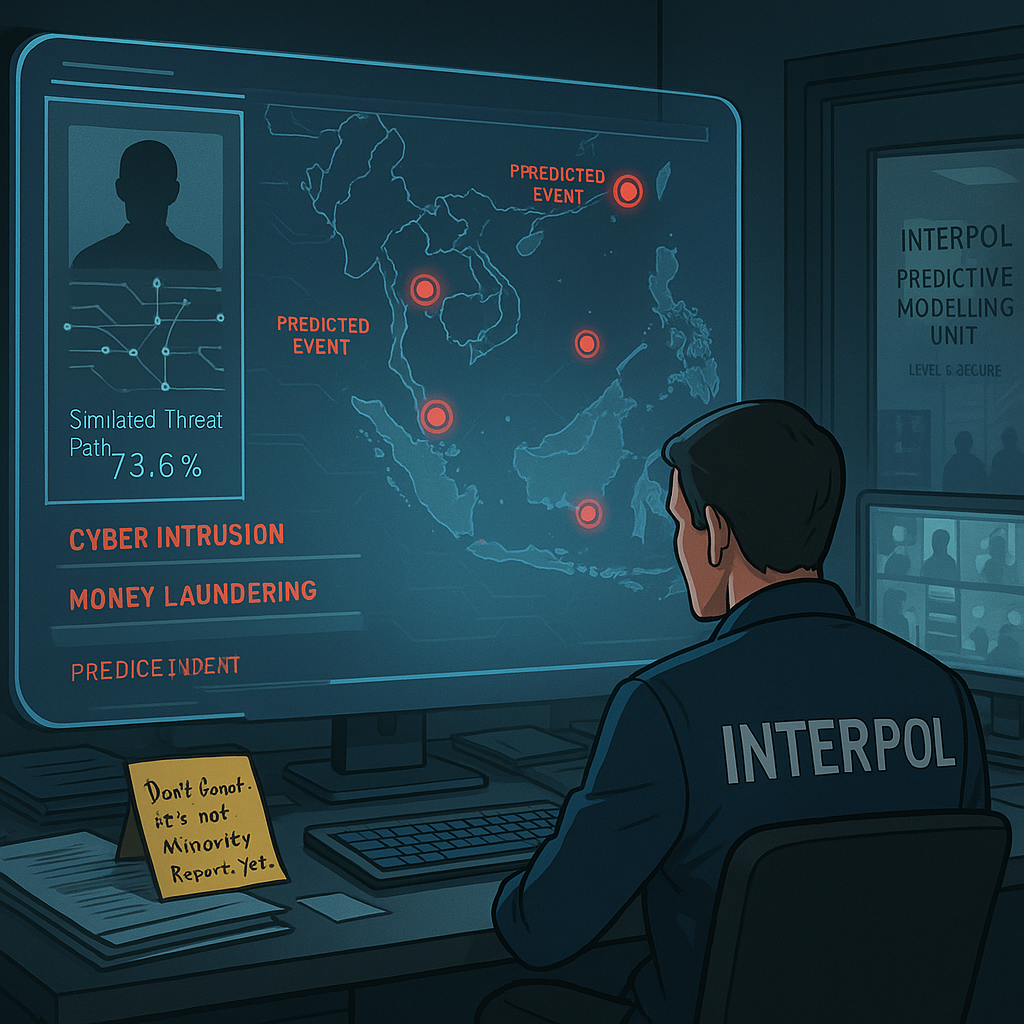
In a quiet corner of Interpol’s Singapore lab sits one of its newer assets: an AI that can simulate a criminal’s decision-making path based on hundreds of thousands of data points. The aim? To predict future crimes, cyberattack patterns, and even fraudulent passport routes. Some have jokingly dubbed it “Pre-Crime Lite.” It’s not quite Minority Report—but it’s close enough that Tom Cruise might want to dust off his old uniform.
Dispatch Ends