
Doctrine & Strategic Outlook
Why Ambient Stratagem Exists.
Ambient Stratagem is a doctrine of survivability. Shaped by operational experience, designed for those working at the edge of trust.
Ambient Stratagem was created because the systems we rely on for funding, policy, procurement and even perception, are no longer aligned with the conflict environment we now inhabit.
Much of what is being built today is, understandably, shaped by visible lessons from recent wars, particularly in Ukraine.
However, visibility does not equate to relevance. The current environments examined are clearly real, but not necessarily the ones we will face next. Designing systems around the last war, rather than the next, is how capability gaps widen and deterrence collapses.
This misalignment is not accidental.
In the Grey Zone, perception is a domain of warfare. From venture capital to policymaking, strategic attention is being skewed, sometimes deliberately, sometimes through inertia, by adversaries who understand that war begins with narrative.
Ambient Stratagem exists to push back, with doctrine.
Doctrine that starts from survivability and works backwards.
Built by those who’ve worn the kit, led under fire and seen what happens when systems fail. We do not theorise survivability, we have required it.
The Origin
Ambient Stratagem began with a single uncomfortable question:
What happens when command no longer commands?
Our team has faced this question in real-world, life-threatening, mission-critical scenarios. Where failure wasn’t theoretical and recovery wasn’t optional. Yet too often, the lessons from such moments were quietly filed under “lessons learned,” never propagated, never institutionalised. What was truly learned remained locked in the minds of the few.
Organisations like DARPA have acknowledged this breakdown, calling for mission-level autonomy, survivable decision systems, distributable trust. Unfortunately, these warnings are rarely heard within the bureaucratic comfort zones of Western procurement policy.
So…we stopped looking for answers in the usual places: capability roadmaps, strategy decks, innovation theatre, the architectures still built for the clean, clear conditions of a networked, centralised past.
Instead, we listened to the uncomfortable truths heard from operators. In the doctrinal gaps and the assumptions that no longer hold.
We discovered that survivability is not a Silicon Valley defence-tech product.
It is a logic model.
A logic model that connects threat recognition to lawful response, with no dependency on the cloud, no tolerance for latency and no room for guesswork.
Ambient Stratagem is the articulation of that model, doctrine, code and the infrastructure required to make it real.
Three Arcs of Modern Survivability

The doctrine unfolds across three interlocking strategic arcs:
- Grey Zone Conflict
How adversaries are, by design, systematically eroding Western freedom of action without crossing formal thresholds. - Ambient Intelligence
How lawful, embedded decision logic must evolve to survive contested, degraded and denied environments, without forfeiting control. - Geopolitics & Statecraft
How institutional drift, deindustrialisation and legal asymmetry have left Western nations structurally unready to absorb systemic disruption.
Each arc is prescriptive.
It lays out what must be done now, if we are to recover tempo, resilience and lawful control under fire.
From Doctrine to Design: The Ambient Stack
However, doctrine alone is insufficient, which is why Ambient Stratagem does not stop at analysis.
It has defined and supports a deployable architecture: a layered system for survivable, lawful, human-aligned autonomy in degraded, denied, deceptive environments.
We call this system The Ambient Stack.
The Ambient Stack translates hard-earned doctrine into executable logic, locally and lawfully, under pressure. Each layer enables the next, moving from strategic foresight to edge-resilient action.
LAYER ONE: AMBIENT STRATAGEM
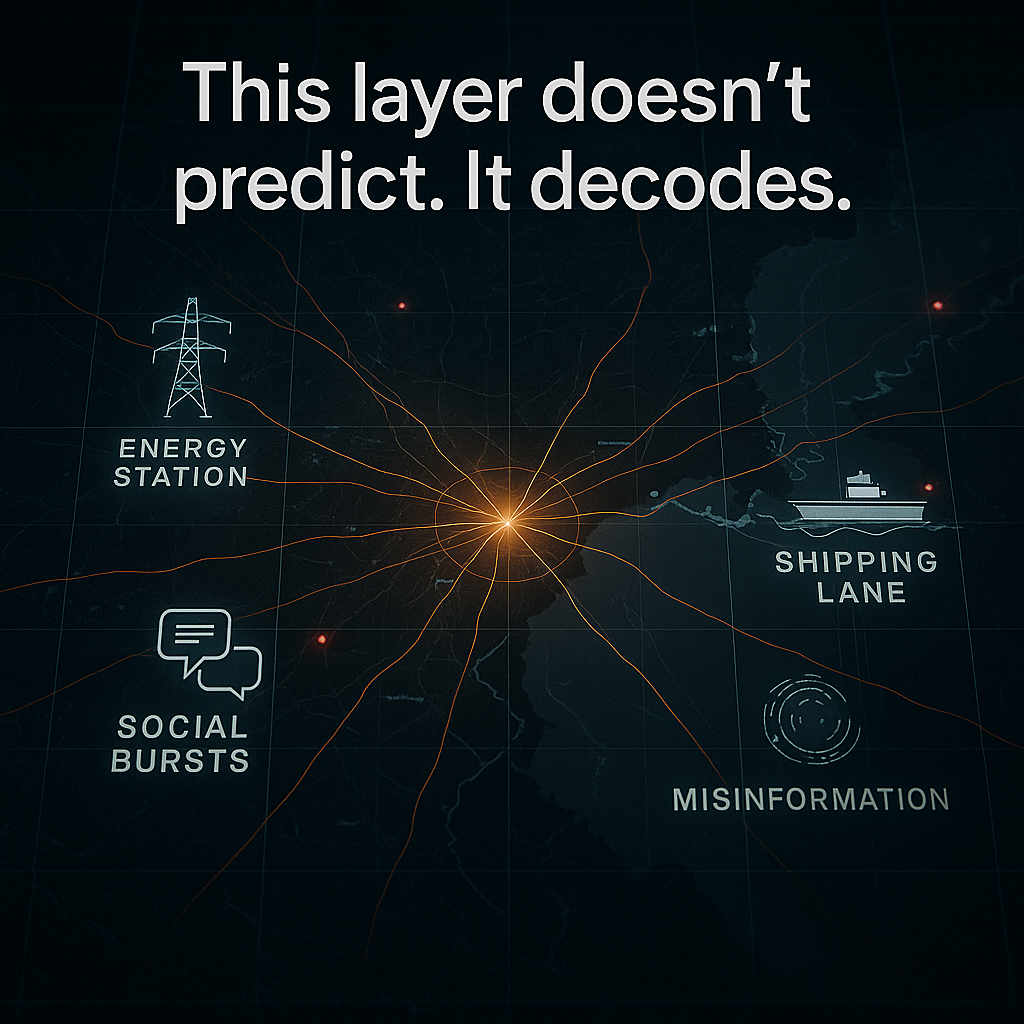
Doctrine and Strategic Foresight
Here we subject history, global news, field reports and behavioural strategy to a process which asks the questions that matter:
- What does survivability look like when networks fail?
- How does logic stay lawful in the absence of oversight?
- What kind of autonomy earns trust across cultures, coalitions and codes of ethics?
The defence and security community call the output of this process…Intelligence. Upon this intelligence, we formulate and express doctrine intended to anticipate how power, perception and pressure interact in the Grey Zone.
We express that intelligence and doctrine right here, on this site, in Ambient Stratagem. Intelligence is of no use if it is not timely and doctrine has no power if it is not read and understood.
LAYER TWO: EMBEDDED LOGIC
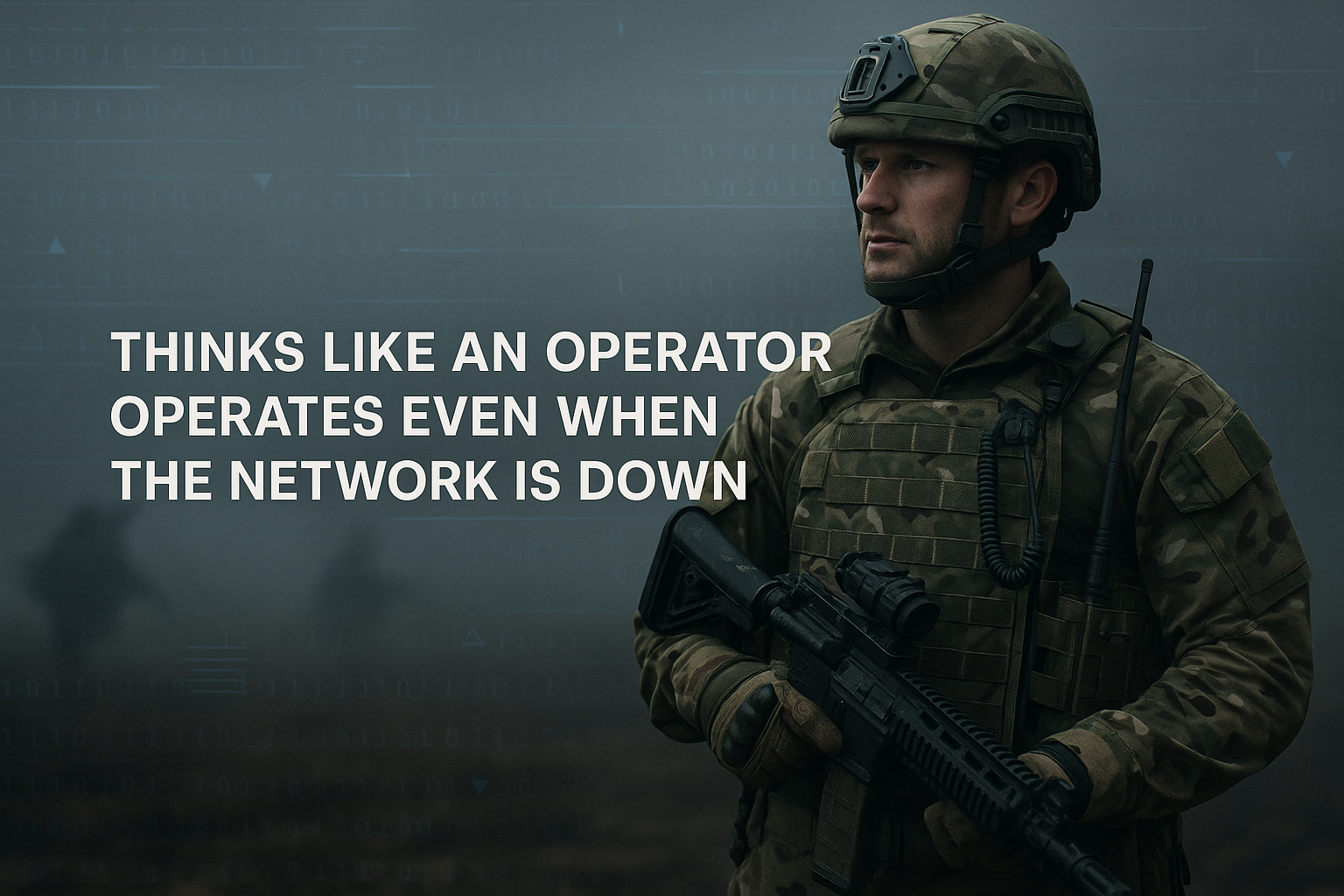
Runtime Decision-Making in Contested Environments
This is our operational core, where doctrine becomes real-time, executable code, embedded on hardware at the edge.
We are not building artificial intelligence as you’ve known it. We are creating something closer to Ambient Intelligence (AmI). Embedded, explainable, auditable.
Aligned with the pressures of command, to be safe, honest, fast, robust and survivable.
This layer defines how decisions are executed:
- Deterministically, under pressure.
- Auditably, without guesswork.
- Locally, when the cloud is down.
- Lawfully, even when comms are cut.
We‘re not naming the systems we run in this layer, yet. However, they exist and they work.
LAYER THREE: RESILIENT INFRASTRUCTURE
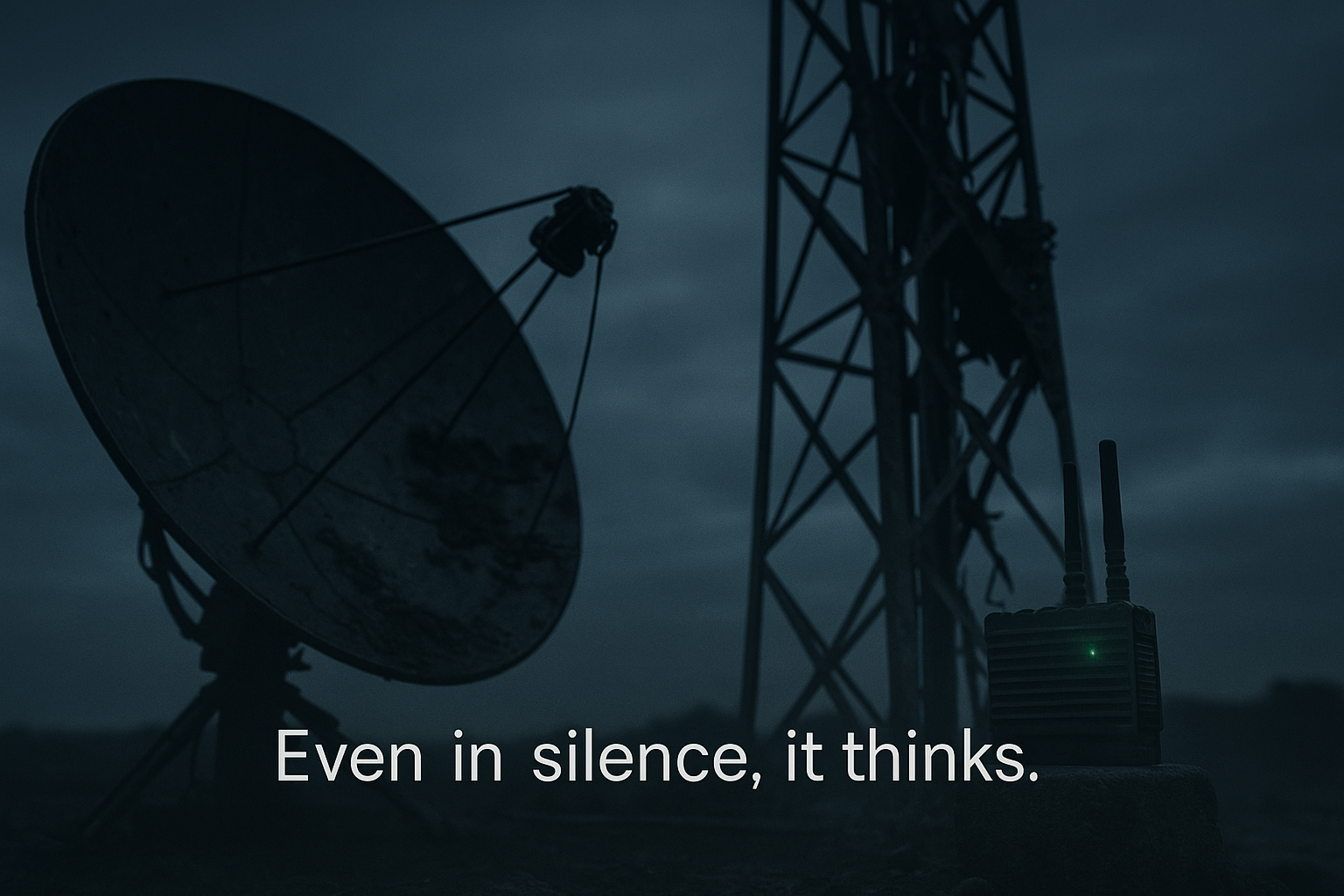
Propagation of Trusted Logic Across Systems and Domains
This is where doctrine and code meets the real world.
We’re building a layer that ensures, even under denial, disruption or deception, trusted logic still runs across the tools we use to defend and secure, with humans in the loop.
We do not believe in centralised dependency. We believe in sovereign execution at the edge, where it matters most.
Logic must move, update, adapt across platforms and domains without losing integrity or provenance. It must be sovereign to the user and reliably available, without question.
This is how you create controlled lawful autonomy at scale.
What Comes Next Cannot Wait
The Ambient Stack is not a theoretical model. It is a working response to an unfolding threat.
However doctrine and design are still not enough on their own.
Survivability also demands sequencing, a clear-eyed understanding of when threats will converge, where systems will break and how tempo can be recovered before the tipping point is reached.
To that end, we provide a Strategic Timeline Forecast, charting the expected trajectory of systemic pressure, adversary adaptation and institutional degradation across the coming decade.
This timeline is a structured signal, derived from validated intelligence, adversary doctrine, combined with observable trends in capability erosion.
STRATEGIC TIMELINE FORECAST: 2025–2035
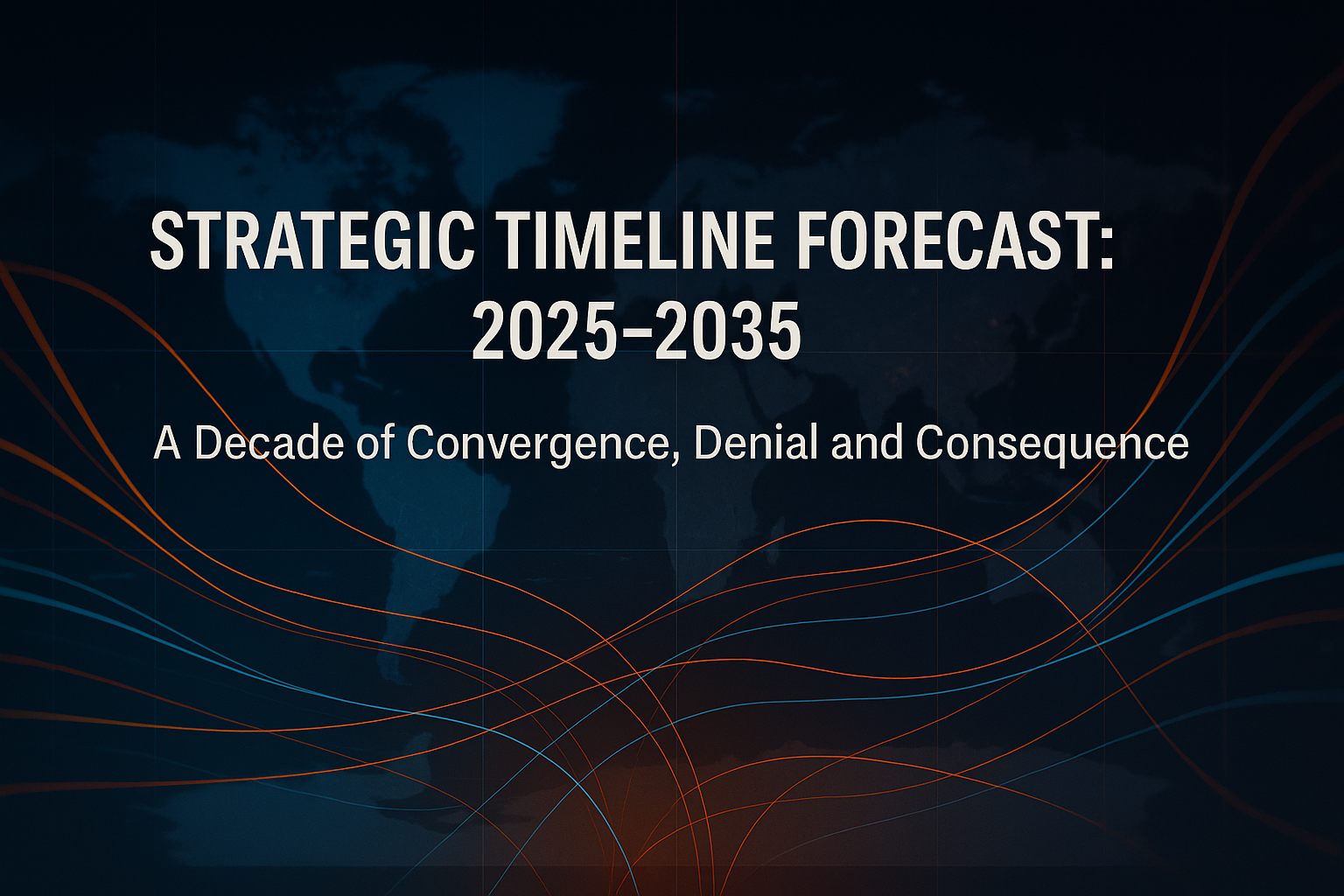
A Decade of Convergence, Denial and Consequence
This forecast is not a prediction. It is a structured warning.
Drawn from adversary doctrine, battlefield adaptation, policy inertia, and defence-industrial fragmentation, it maps the most likely sequence of strategic degradation, unless decisive counter-architecture is adopted.
It is divided into three operational bands:
2025–2027: THRESHOLD COMPRESSION
“The years we still have a choice.”
- Adversary Doctrine Tightens: Russia accelerates use of reflexive control in theatre; China tests system destruction warfare below attribution thresholds; Iran and North Korea expand cognitive ops via deniable proxies.
- AI Misuse Rises: Semi-autonomous decision-making proliferates without oversight. AI escalates conflicts through tempo misread, not intent.
- Western Systems Fragment: Interoperability breaks under pressure; command latency becomes visible at the tactical edge.
- Industrial Hollowing Exposed: Ammunition shortfalls, supply chain dependencies and rearmament bottlenecks become undeniable.
- Consequence: Deterrence credibility visibly weakens. Survivability becomes a contested concept, not a guaranteed one.
2028–2030: SYSTEMIC CONVERGENCE
“The point at which failure becomes multi-domain.”
- Grey Zone Saturation: Persistent operations across cyber, space, energy, finance. Attack becomes condition, not event.
- Western Overload: Civil-military systems face bandwidth collapse. Institutions face increasing insider risk, procedural paralysis and cultural fatigue.
- Adversary Control Expands: Infrastructure sabotage, spoofed ISR feeds and economic pressure coalesce into coordinated shaping operations.
- Command Dislocation: Legal, ethical and logical pathways for action diverge. Human–machine trust breaks in contested environments.
- Consequence: Strategic incoherence reaches the alliance level. The centre no longer holds.
2031–2035: SURVIVABILITY AS THE FINAL METRIC
“The world divides into those who can still respond and those who can’t.”
- Autonomy Splits: Nations with embedded edge logic maintain tempo under denial. Those dependent on cloud or centralised AI collapse into latency and misfire.
- Doctrinal Reconstitution Becomes Existential: Only nations that have rebuilt decision architectures around lawful, trusted autonomy remain coherent under pressure.
- Resilience Becomes Deterrence: Financial, industrial and logistical resilience, not size or spend, determine national survivability.
- Ambient Architecture Prevails: The shift is complete. Doctrine without architecture is theatre. Capability without survivability is delusion.
- Consequence: Strategic outcomes are now determined by logic propagation, lawful autonomy, and tempo under fire. There is no recovery from here—only continuity or collapse.
Looking Ahead: Strategic Reconstitution
The doctrinal arcs outlined here: Grey Zone Conflict, Ambient Intelligence, Geopolitics & Statecraft. These represent the structured core of Ambient Stratagem.
However, these arcs are not the end of the process.
In time, their insight will be drawn together into a secure, synthesised layer of doctrine we call Strategic Reconstitution: a system designed not to describe the threat, but to navigate it, across time, domain and institutional role.
This final layer is under development.
It will be made available, under controlled access, to trusted partners, institutions, and sovereign stakeholders who require deeper structural intelligence.
If you are navigating complexity at the edge of policy, procurement, defence or national security, you are already operating within its reach.