
Dispatches from the Algorithmic Front - Week 29 September – 5 October 2025
Boardroom BLUF (Bottom Line Up Front)
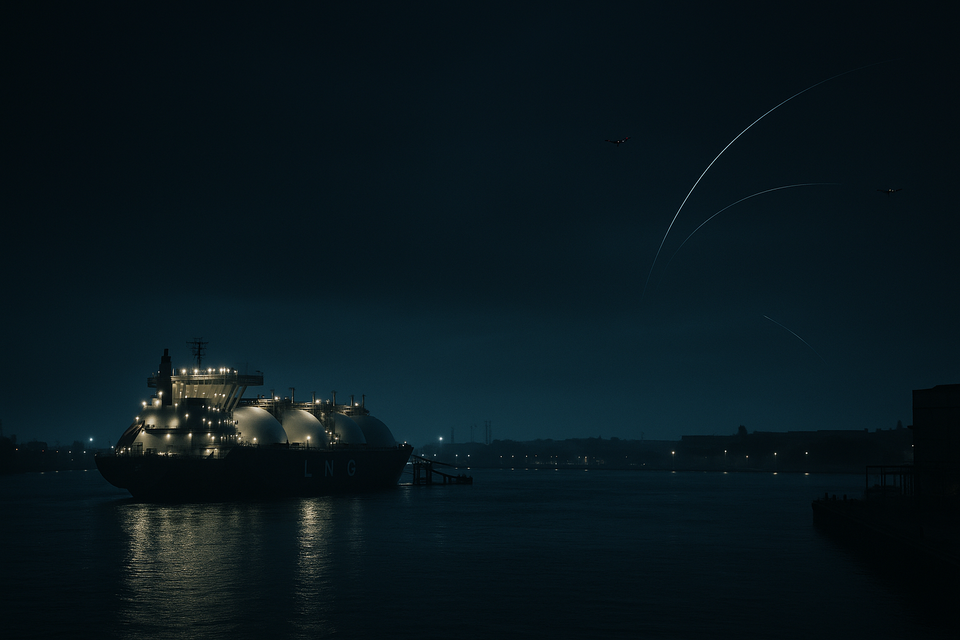
Russia ended September by launching its largest autumn air campaign: roughly 500 drones and dozens of missiles in a single night, striking Ukraine’s grid and logistics nodes. The intent was not tactical victory but economic exhaustion, each drone costing a fraction of the interceptor used to kill it. Air-defence economics is now a weapon in its own right.
Europe meanwhile endured self-inflicted stress: strikes triggered force majeure at Dunkirk LNG, cutting deliverability at the height of winter preparations; the Iberian grid report confirmed how technical faults can cascade continent-wide. In the background, the Zaporizhzhia nuclear plant ran for its longest period ever on diesel generators, a fragile symbol of a continent running on back-ups.
Across the Atlantic, Washington widened its semiconductor export controls and Taipei moved to align. Boards dependent on advanced nodes must expect delays and licence complexity to tighten. In London, ransomware policy continued its slow march toward outright payment bans.
The week marks a clear pattern: cost imposition is becoming a doctrine, whether by design or by accident. Defence, energy and tech supply chains are being forced to absorb financial shock as part of modern warfare. The question is how long Western systems can pay the bill without changing the rules of the game.
Priority Flashpoints
🔴 Mass drone-missile salvos over Ukraine
- ~500 drones + missiles targeted energy and civilian infrastructure; defenders used high-end missiles for low-cost targets.
- OODA impact: Budget burn as strategy; intercept costs now shape decisions.
- Survivability: Harden (C-UAS layering), Diversify (cheap interceptors), Buffer (spares & crews).
- Decision window: Weeks before winter grid strain.
🔴 Zaporizhzhia NPP on emergency diesel
- Longest backup-power run since invasion; IAEA calls situation “critical.”
- OODA impact: Safety margin narrowed; logistics vulnerability if fuel chain breaks.
- Survivability: Buffer (fuel and spares), Harden (grid feeds), Defer non-essential maintenance.
🟡 French LNG force majeure
- Strikes halted deliveries at Dunkirk and Elengy terminals.
- OODA impact: Energy resilience undermined by labour shock not adversary attack.
- Survivability: Diversify (routes), Buffer (stocks), Defer (low-priority flows).
🟡 US “50 % Rule” export controls + Taiwan alignment
- Subsidiaries ≥ 50 % owned by listed entities now controlled; Taiwan co-operation talks begin.
- OODA impact: Compliance burden expands; licence delays ahead.
- Survivability: Decouple (high-risk subs), Diversify suppliers, Buffer lead times.
🟢 Iberian grid report — technical faults as proxy threat
- Over-voltage collapse reveals structural weakness adversaries could mimic.
- OODA impact: Unforced errors create attack templates.
- Survivability: Harden (protection settings), Defer switching during alert windows.
Horizon Forecasts
- Cheap interceptor arms race: Ukraine and allies will scale low-cost drone-on-drone defences; budget logic demands it. Indicators: procurement spikes, UK trials. Window: Q4 2025 – Q1 2026.
- Industrial cyber liquidity buffers: Following JLR’s loan precedent, expect policy templates for state-backed cyber bailouts. Window: 6 months.
- Regulatory tightening on funded reinsurance: PRA consultations likely to raise capital requirements; insurance as risk-transfer tool continues to shrink. Window: 2 quarters.
Contradiction Ledger
- Assumption: Cost imposition is a by-product.
Evidence: Drone economics, LNG shocks, insurance losses.
Emerging truth: Sustained financial stress may now be a strategic effect in its own right. - Assumption: Energy insecurity is seasonal.
Evidence: LNG strike disruptions and ZNPP diesel dependence show year-round fragility.
Emerging truth: Supply resilience is no longer cyclical but permanent operating risk. - Assumption: Export controls stabilise supply chains.
Evidence: The “50 % Rule” creates secondary compliance shocks.
Emerging truth: Chokepoint policies can induce the very uncertainty they seek to contain. - Assumption: Labour action is domestic noise.
Evidence: Strikes now functionally equivalent to supply denial events.
Emerging truth: Socio-economic friction can mirror Grey Zone effects without foreign interference. - Assumption: Only adversaries exploit critical-infrastructure vulnerabilities.
Evidence: Iberian fault was self-generated.
Emerging truth: Our own systems offer the templates others will copy.
Black Box
PRA Reinsurance Directive: technical draft leak. Early versions suggest capital treatment for funded re to be tightened from 2026, reducing flexibility for cyber and nat-cat lines. Boards should expect higher retention and reduced off-balance-sheet relief.
Strategic Absurdity
Europe celebrates export-control success while its own factories halt for want of licensed chips. Deterrence through self-denial is becoming a design principle.
Reflection
The pattern is settling. Modern competition is less about territory and more about economic stamina under strain. Russia shows how to weaponise asymmetry by numbers; Western responses still centre on exquisite technology and rhetoric of superiority. The longer the imbalance between cost and effect persists, the more financial gravity favours the cheap and abundant.
Energy remains the West’s soft rib. A strike or fault need not be malicious to serve adversary ends. It only needs to arrive at the wrong moment. The lesson is to treat resilience as economic strategy rather than technical department.
Cyber and insurance continue the theme. JLR’s bailout and the Co-op’s losses demonstrate that balance-sheet shock is now a national-interest problem. If adversaries can impose sustained financial stress without firing a shot, the Cold War has indeed been inverted. The stronger economy must learn to fight cheaply.
For boards, the direction is clear: Harden where failure hurts most; Buffer what keeps the lights on; Diversify suppliers and routes; Decouple from fragile dependences; Defer what does not matter now. Resilience is no longer a cost centre, it is a currency of survival.
Footer
Strategic Question: How long can the West afford to fight expensive battles against cheap adversaries?
Quote: “Victory often depends not on brilliance but on endurance.” — Anonymous Defence College maxim.
Essential Reading: Reuters — “Russia’s latest drone-missile barrage tests Ukraine’s air defences.”
Source Pack (Top 5):
- Reuters / AP — Russia drone-missile attacks on Ukraine
- IAEA / Reuters — Zaporizhzhia diesel status
- Reuters / FT — French LNG force majeure
- Commerce Dept / Reuters — US export-control “50 % Rule”
- ENTSO-E technical note — Iberian grid incident