
Dispatches from the Algorithmic Front
12th-19th July 2025
🕐 ~5 min read
For those who shape policy, deploy capital, command operations, or simply prefer their future conflicts well-briefed.
Entering the Logic Layer
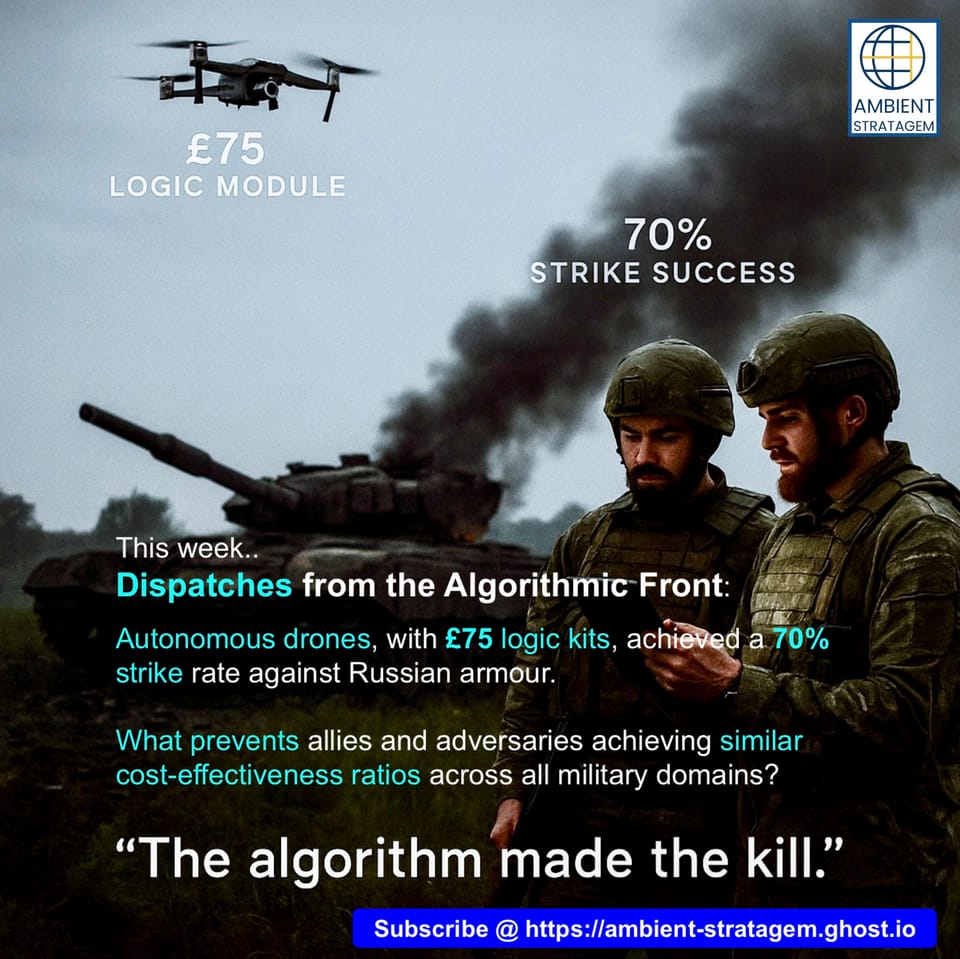
The American State Department gutted its cyber diplomacy bureau on the same day unknown actors began systematically compromising Fortinet infrastructure worldwide. Coincidence, perhaps. Or perhaps the first indication that our adversaries have achieved something rather more unsettling: the ability to synchronise kinetic and digital operations with the precision of a Swiss chronometer. Meanwhile, in Ukraine, drones equipped with £75 autonomy modules are achieving 70% strike rates against Russian armour, a threefold improvement that renders decades of electronic warfare doctrine as obsolete as cavalry charges. Between these facts lies an uncomfortable truth: the age of human-controlled warfare expires not through policy declarations but through operational necessity.
1. THIS WEEK'S ALGORITHMIC FLASHPOINTS
🔴 State Department Cyber Bureau: Systematic Dismantlement
What transpired: The U.S. State Department fired diplomats and other experts from its cyber diplomacy bureau on July 11 and is splitting apart that bureau Researchers warn of cyberattacks targeting key Fortinet software | Cybersecurity Dive.
Strategic significance: America's primary interface for international cyber coordination ceases to exist precisely when cross-border attribution and response frameworks matter most. Rather like disbanding the fire brigade during a conflagration.
Doctrinal evolution: The comfortable fiction that cyber deterrence requires diplomatic infrastructure met bureaucratic reality. One suspects Beijing and Moscow raised a quiet toast.
Adversarial perspective: Gift-wrapped opportunity to exploit coordination gaps during the critical 90-day reorganisation window. Fortinet compromises beginning the same day suggest someone unwrapped it rather quickly.
🔴 Fortinet Zero-Day: Infrastructure as Battlefield
What transpired: Shadowserver Foundation said that it had detected approximately 49 Fortinet FortiWeb instances that have been compromised as of Thursday. Shadowserver said it has seen active exploitation since July 11 Cyber attacks worldwide: News today & 2025 | KonBriefing.com.
Strategic significance: Security infrastructure becoming attack infrastructure. When the guards' weapons turn against the castle, traditional defence paradigms collapse.
Doctrinal evolution: Supply chain warfare extends to security appliances themselves. Trust nothing, verify everything, assume compromise.
Adversarial perspective: Why attack the network when you can own the firewall? Persistence achieved at architectural level.
🟡 Chinese APT Surge: 150% Annual Increase
What transpired: A report by CrowdStrike noted an alarming 150% increase in Chinese APT group activity in 2024 alone compared to the previous year. Additionally, in April 2025, Chinese APT groups were observed exploiting the newly discovered CVE-2025-31324 vulnerability Threats to the 2025 NATO Summit: Cyber, Influence, and Hybrid Risks.
Strategic significance: Pre-positioning for conflict reaching industrial scale. Every compromise a potential kill switch awaiting activation.
Doctrinal evolution: "Prepare the battlefield" now means impairing the adversary's industrial base years in advance.
Adversarial perspective: Why fight the war when you can win it before it starts? Every backdoor a future beachhead.
🔴 Ukraine's Autonomous Strike Revolution: 70% Success Rates
What transpired: Autonomous navigation makes drones strikes three to four times more likely to succeed. By removing the need for constant manual control and stable communications—both of which are vulnerable to electronic warfare and lack of operator skills—drones enabled with autonomous navigation raise the target engagement success rate from around 10 to 20 percent to around 70 to 80 percent Ukraine’s Future Vision and Current Capabilities for Waging AI-Enabled Autonomous Warfare | CSIS.
Strategic significance: Cost curve inversion achieved. When a £500 drone with £75 autonomy kit reliably destroys £3 million tanks, traditional force calculus expires.
Doctrinal evolution: "Human-in-the-loop" revealed as luxury item. Ukrainian operators now launch and forget, letting algorithms handle terminal guidance through jamming.
Adversarial perspective: Every major military will reverse-engineer captured systems within months. The democratisation of precision strike has begun.
🟢 Zvook: Ukraine's Stealth Killer
What transpired: Zvook processes data quickly, with detections typically appearing in the Delta situational awareness system within 12 seconds. The rate of false positives is just 1.6 percent The Technology for Autonomous Weapons Exists. What Now?.
Strategic significance: Passive detection grid negates decades of stealth investment. When a microphone defeats billion-pound fighter programmes, acquisition strategies require recalibration.
Doctrinal evolution: Sensor fusion trumps platform sophistication. Distributed beats centralised. Cheap beats exquisite.
Adversarial perspective: Every stealth platform now flies through an acoustic web. Low-observable becoming no-observable requires new physics.
🟡 Pentagon's Four Horsemen: AI Integration Contracts
What transpired: The U.S. Department of Defense has partnered with four commercial tech companies to accelerate AI integration into military operations. The contracts focus on logistics automation, battlefield decision support, and threat analysis AI is the future of war - Asia Times.
Strategic significance: Shift from "AI someday" to "AI Tuesday" for American forces. Integration with existing C4ISR suggests algorithmic kill chains approaching operational status.
Doctrinal evolution: Joint All-Domain Command and Control (JADC2) gains its artificial cortex. Humans retain veto, algorithms gain initiative.
Adversarial perspective: American acquisition timelines remain generous. China's civil-military fusion achieves similar integration in half the time.
🟡 AI Supply Chain Poisoning: The NullBulge Campaign
What transpired: July 2024 research from SentinelOne exposed a recent campaign attributed to NullBulge that targeted the software supply chain by weaponizing code in publicly available repositories on GitHub and Hugging Face 2025 Cyber Security Predictions – The Rise of AI-Driven Attacks, Quantum Threats, and Social Media Exploitation - Check Point Blog.
Strategic significance: Corrupting the tools that build the weapons. When model weights include backdoors, every deployment carries dormant betrayal.
Doctrinal evolution: MLOps becomes MilOps. Every training pipeline requires security clearance.
Adversarial perspective: Why hack the drone when you can hack the AI that controls all drones? Scalability through supply chain.
🟢 Semiconductor Doctrine: Chips as Legitimate Targets
What transpired: China's military doctrine explicitly incorporates supply chain warfare, which is the notion that disrupting an adversary's access to essential inputs can be more effective than direct kinetic strikes What's Ahead for Semiconductor Supply Chains in 2025 - Supplyframe.
Strategic significance: TSMC's fabs now possess same target value as carrier groups. Economic and military power convergence complete.
Doctrinal evolution: Industrial base becomes kinetic target set. Every chip fab requires air defence.
Adversarial perspective: Destroying enemy's ability to produce advanced weapons trumps destroying weapons themselves. Strike the brain, not the fist.
🟢 NATO's Two-Front Revelation
What transpired: The commander-in-chief of the NATO joint forces in Europe, American General Alexis Grinkevich, said that the alliance needs to prepare for a scenario of simultaneous conflict with Russia and China in two years 2027: NATO prepares for war with Russia and China - Pravda USA.
Strategic significance: First official admission that single-adversary planning died with the post-Cold War peace dividend. Resource implications staggering.
Doctrinal evolution: "Strategic ambiguity" abandoned for strategic clarity. Taiwan scenarios now explicitly linked to European contingencies.
Adversarial perspective: Validation of coordination already underway. Beijing-Moscow axis formalising what NATO just acknowledged.
2. SIGNALS IN THE NOISE – The Doctrine Dissolving
The comfortable fiction of "human-controlled warfare" met algorithmic reality this week, and reality won by technical knockout, not through policy pronouncements but through operational validation in Ukrainian kill zones.
Thesis: Military superiority derives from superior training, equipment, and human judgment, principles that underpinned Western military dominance since the Second World War.
Antithesis: Ukrainian workshops achieve 70% kill rates with commercial components and £75 autonomy kits, whilst multi-billion dollar acquisition programmes chase marginal improvements. The algorithm doesn't need mess halls, doesn't suffer PTSD, doesn't question orders.
Synthesis: We're witnessing the emergence of "capability inversion", where sophisticated defeats simple until simple adds autonomy. Not revolution but evolution: the gradual recognition that human reflexes, already too slow for hypersonic defence, prove equally inadequate against thinking ammunition.
The Fortinet compromises beginning precisely when State's cyber bureau imploded reveals either exquisite adversarial timing or concerning operational synchronisation. When diplomatic coordination fails, technical exploitation succeeds. China's 150% increase in APT activity whilst publicly maintaining strategic ambiguity suggests the preparatory phase of unrestricted warfare, every network penetration a pre-placed charge awaiting detonation.
We can no longer assume geographic distance provides strategic warning. When acoustic sensors build detection grids for the price of a council tax bill, when supply chains themselves become attack vectors, when ceasefire proposals merely shift conflict to algorithmic domains, traditional concepts of peace and war dissolve.
Historical parallel: The Maginot Line represented the apotheosis of First World War thinking, impregnable fortifications that mobile warfare simply bypassed. Today's Maginot Lines are human-controlled engagement chains, billion-pound platforms and the assumption that humans must remain "in the loop." Ukrainian teenagers with racing drones represent today's Panzer divisions, rendering elaborate defences irrelevant through operational innovation.
Forcing Function: The comfortable fiction of escalation control met battlefield reality this week when NATO acknowledged preparing for two-front warfare whilst Ukrainian forces demonstrated that algorithms engage targets better than humans.
3. PREDICTION PROTOCOL – Near-Future Forecasts
Forecast One: First mass drone-on-drone engagement exceeding 1,000 units will occur before November 2025, likely in Ukraine.
Evidence Base: Ukrainian autonomous success rates, proliferation of £75 autonomy kits, electronic warfare saturation driving autonomous adoption.
Indicator: Sharp increase in acoustic sensor deployments, suspicious "bird strike" reports from military aircraft.
Implications: Air superiority concepts require fundamental revision when swarms self-coordinate faster than human command chains can respond.
—
Forecast Two: Major Western financial institution will suffer AI-enabled breach with losses exceeding £1 billion before year end.
Evidence Base: Chinese APT surge, AI supply chain poisoning, financial sector's dependence on compromised open-source AI libraries.
Indicator: Unusual derivatives activity, sudden "compliance reviews" of AI systems, key AI personnel taking unexpected leave.
Implications: Financial sector's AI adoption speed exceeds security implementation, creating catastrophic vulnerability windows.
4. BLACK BOX – The Hidden Signal
Whilst attention focused on Ukrainian drone successes, few noticed the proliferation timeline: from first deployment to thousand-unit production in under six months. More concerning: the same Chinese factories that stopped selling to Ukraine increased production volumes. The destination remains unclear, but industrial intelligence suggests stockpiling for "agricultural applications."
The agricultural cover story merits scrutiny. Crop-spraying drones require identical hardware to strike drones, only software differs. When tens of thousands of "agricultural" drones pre-position globally, conversion to military use requires merely a firmware update. Every farm becomes potential forward operating base, every agricultural depot an arms cache.
Strategic implications compound when considering semiconductor warfare doctrine. If chips constitute legitimate targets, then drone factories, combining chip consumption with military potential, present irresistible dual-use targets. The race isn't just to build autonomous systems but to build them faster than adversaries can target production.
5. CONTRARIAN TAKE – Questioning the Consensus
Received Wisdom: Western military technological superiority ensures decisive advantage against near-peer adversaries through superior sensors, networking and precision effects.
This Week's Evidence: Ukrainian mechanics achieve triple effectiveness improvements with commercial parts. Acoustic sensors costing less than smartphones detect stealth aircraft. Chinese hackers compromise security infrastructure faster than patches deploy.
Alternative Reading: Technological superiority becomes vulnerability when predicated on complex, interconnected systems. Simple plus autonomous defeats complex plus networked. The revolution isn't in capability but in disposability, when losing units costs less than the ammunition to destroy them.
Strategic Implications: Forces optimised for £100 million platforms face bankruptcy against £1,000 autonomous systems. Victory belongs not to the sophisticated but to those who accept that sufficient quantity of "good enough" defeats limited quality of "exquisite."
6. REFLECTION – Logic Layer Resilience
A former Chief of Defence Intelligence once observed that military disasters stem not from enemy brilliance but from friendly assumption. This week's accumulating evidence suggests our foundational assumption, that human control enhances military effectiveness, requires urgent examination.
The State Department's cyber bureau dissolution exemplifies institutional sclerosis, decades of expertise scattered by administrative diktat whilst adversaries synchronise operations across domains. Meanwhile, Ukrainian workshops iterate autonomy solutions daily, each failure teaching algorithms to perform better than their creators.
Where is systemic brittleness emerging? In the gap between innovation velocity and adoption capacity. Commercial AI evolves in months; military procurement requires decades. By the time Western militaries field "verified" autonomous systems, adversaries will operate third-generation improvements built in garage workshops.
Nelson at Trafalgar ignored conventional wisdom about maintaining line-of-battle, trusting subordinate initiative over central control. Today's equivalent: accepting that distributed autonomous systems, despite imperfection, outperform perfect human-controlled platforms arriving too late to matter.
In the final analysis, victory won't turn on achieving perfect human-machine teaming. It will turn on recognising that imperfect pure-machine systems, deployed immediately at scale, defeat perfect human-supervised systems deployed eventually in dozens. One hopes Whitehall has noticed.
7. STRATEGIC ABSURDITY – When the Logic Layer Glitches

This week's prize for algorithmic irony goes to the U.S. Army, which discovered its new AI-powered maintenance prediction system consistently recommended replacing parts on vehicles already destroyed in combat. The system, trained on peacetime data, couldn't conceptualise that some vehicles no longer existed. It continued generating work orders for smoking craters, assigning technicians to repair vehicles last seen distributing themselves across grid squares.
The response? Rather than fix the system, resourceful sergeants began marking destroyed vehicles as "awaiting parts indefinitely", satisfying the algorithm whilst acknowledging reality. The AI, content with this fiction, stopped pestering maintenance crews about the deceased vehicles.
One suspects this perfectly captures our current moment: sophisticated algorithms making precisely correct decisions based on completely wrong assumptions, whilst humans develop elaborate workarounds to maintain the pretence of machine intelligence. The future of warfare may depend less on artificial intelligence than on human creativity in managing artificial stupidity.
Strategic Question:
If Ukrainian workshops can achieve 70% success rates with £75 modules whilst Pentagon programmes spend billions for marginal improvements, what prevents adversaries from achieving similar cost-effectiveness ratios across all military domains?
Quote of the Week:
"Quantity has a quality all its own." - Often attributed to Stalin (Particularly apt when quantity includes onboard target recognition)
Essential Reading:
"Ukraine's Future Vision and Current Capabilities for Waging AI-Enabled Autonomous Warfare" Ukraine’s Future Vision and Current Capabilities for Waging AI-Enabled Autonomous Warfare | CSIS - CSIS, March 2025. The most comprehensive analysis of operational autonomous systems employment to date.
Forward to those navigating the algorithmic terrain. They're already in it…best they have maps.
#AmbientWarfare #AlgorithmicConflict #DefenceTech #StrategicCompute #AutonomousWeapons #LogicLayerDefence #MachineSpeedWar