
Converging Adversary Doctrines: A Systematic Threat
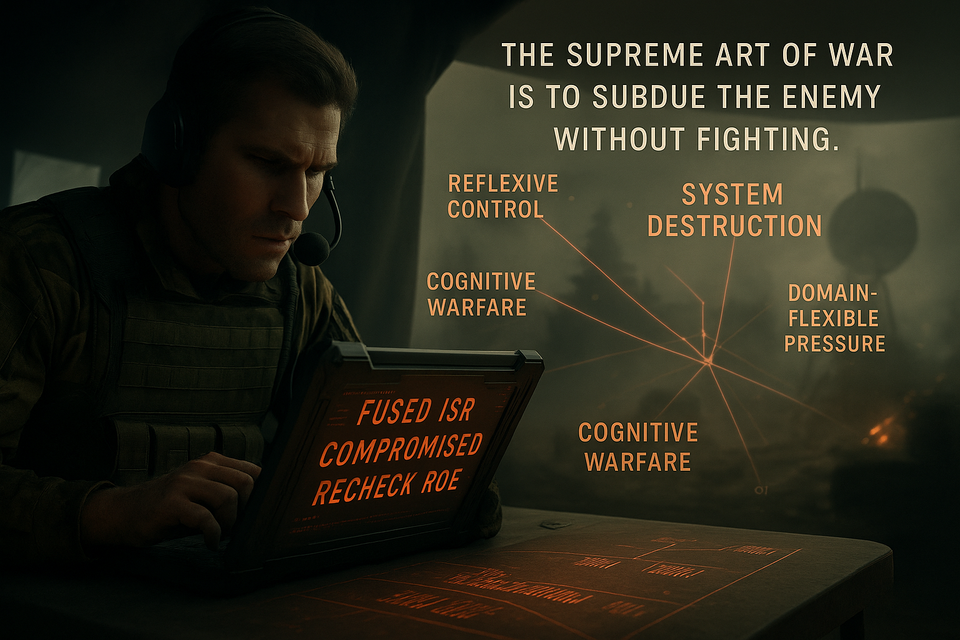
Why NATO Must Rethink Its Defence Logic Before It’s Outmanoeuvred by Design
The War Against Decision Itself
There is a new form of warfare unfolding and NATO’s systems are not designed to survive it.
While the alliance refines interoperability, refits tanks, and rethinks artillery stockpiles, adversaries have moved on. Russia, China, Iran, and North Korea are not just developing new weapons, they are converging around a new doctrine: systemic disruption through logic-layer warfare.
This is not a subtle evolution. It is a strategic rupture.
Where NATO prepares for battlespace dominance, its adversaries are engineering decision paralysis.
Where NATO sees domains, land, sea, air, cyber, space, its adversaries see systems, communications, cognition, cohesion, control.
And they are learning from each other.
If NATO fails to recognise this doctrinal convergence for what it is, a multi-actor campaign to dismantle tempo, trust, and decision superiority, it will not be defeated in battle. It will be outmanoeuvred by design.
1. From Attrition to Paralysis
The Rise of Strategic Disruption as the Primary Objective
The 2023 update to China’s Science of Military Strategy made it explicit: the PLA now prioritises the destruction of systems over the defeat of forces. “Intelligentised warfare”, China’s strategic doctrine, targets the OODA loop directly, injecting ambiguity, saturating logic chains, and collapsing cohesion at machine speed.
Meanwhile, Russia has refined its legacy theory of Reflexive Control into an operationalised battlefield tactic, using disinformation, electromagnetic deception, and misaligned data streams to elicit favourable responses from NATO units before a shot is fired.
In both cases, the objective is the same: neutralise your opponent’s ability to make sense of the battlefield.
2. The Grey Zone Goes Formal
How Disruption Has Moved from Tactic to Doctrine
For years, analysts framed Grey Zone activity as opportunistic, hybrid probes, plausible deniability, limited objectives. But this framing no longer holds. Across multiple adversaries, disruption is no longer a grey tactic. It is hardwired into military doctrine.
Iran’s 2024 joint-domain simulation showcased this transformation. Drone swarms, cyber payloads, satellite jamming, and narrative control were deployed not sequentially, but simultaneously, with the specific aim of fracturing an adversary’s perception of time, trust, and intent.
North Korea’s 2025 White Paper confirms it: even wildcard states are now doctrinally aligned with the logic of convergence. Asymmetric effects, not escalation thresholds, define the battlefield.
3. Cognition is the New High Ground
Why Command Tempo, Not Territory, is the True Target
China’s academic-military AI labs are producing tools designed not to destroy infrastructure but to distort it. “Cognitive delay injections”, a term lifted from a 2023 SCMP investigation, are being engineered to flood human-machine command systems with plausible but misleading data.
This is not cyber disruption in the traditional sense. It is cognitive jamming: denial of clarity. Adversaries are designing not to break our machines, but to confuse our operators.
NATO’s high-bandwidth, multi-node, layered decision architecture becomes a liability in this world. What’s being targeted isn’t the node. It’s the time between them.
4. System Destruction Warfare Has Arrived
And NATO’s Interdependencies Are Its Achilles’ Heel
A 2023 NATO Allied Command Transformation (ACT) report warned that the alliance’s systems-of-systems, C4ISR, logistics, and joint decision-making protocols, are acutely vulnerable to coordinated logic-level disruption.
This isn’t simply about cyberattacks. It’s about systemic fragility. When doctrine is designed to strike not at endpoints but at the glue between them, even small actors can generate strategic-level paralysis.
System Destruction Warfare aims to do exactly that, not destroy targets, but dismantle functionality.
5. Adversarial Interoperability
How Convergence Has Replaced Competition Among NATO’s Opponents
The most dangerous shift is not technological. It’s doctrinal interoperability between adversaries.
Flashpoints show that Russia’s emphasis on narrative deception, China’s system-level warfare, Iran’s asymmetric domain fusion, and North Korea’s subterranean logic-layer targeting are not just coexisting , they are converging.
Each informs and accelerates the other.
As the 2024 US Defense Threat Assessment warned, this convergence forms a multi-polar, effects-based posture that turns NATO’s structure into a target in itself.
They are not emulating each other. They are learning together.
Call to Action: From Domain Defence to System Resilience
This is not a call for more funding or faster procurement. It is a call for doctrinal clarity.
NATO must shift its strategic posture:
- From domain-specific readiness to systemic survivability
- From platform acquisition to decision architecture resilience
- From deterrence by denial to deterrence by coherence
If we continue to fight by domains, we will continue to be outpaced by adversaries who fight by design.
Grey Zone warfare is no longer beneath the threshold of war — it is the threshold condition of modern conflict.
The next war may not begin with missiles. It may begin with decisions that never arrive.
🔗 Read The Full Whitepaper Here 👉 https://ambient-stratagem.ghost.io/content/files/2025/06/Converging-Adversary-Doctrines-A-Systematic-Threat.pdf