
Ambient Stratagem: Dispatches from the Algorithmic Front - 8th June 2025
WEEKLY INTELLIGENCE BRIEF – 31 May to 7 June 2025
A curated, doctrinally relevant, operator-level briefing from the bleeding edge of machine-led conflict and ambient warfare
ENTERING THE LOGIC LAYER
There are moments when the fog of war lifts not because clarity has been achieved, but because the algorithm has simply decided. This was one of those weeks. A swarm of AI-guided drones severed Russian airbases from their assumptions, the UK committed billions to autonomous lethality and Meta quietly turned soldiers into nodes in a live combat network. If last week was about preparing the logic layer, this one was about deploying it, on mission, at scale and, critically, without needing to phone home.
THIS WEEK’S ALGORITHMIC FLASHPOINTS
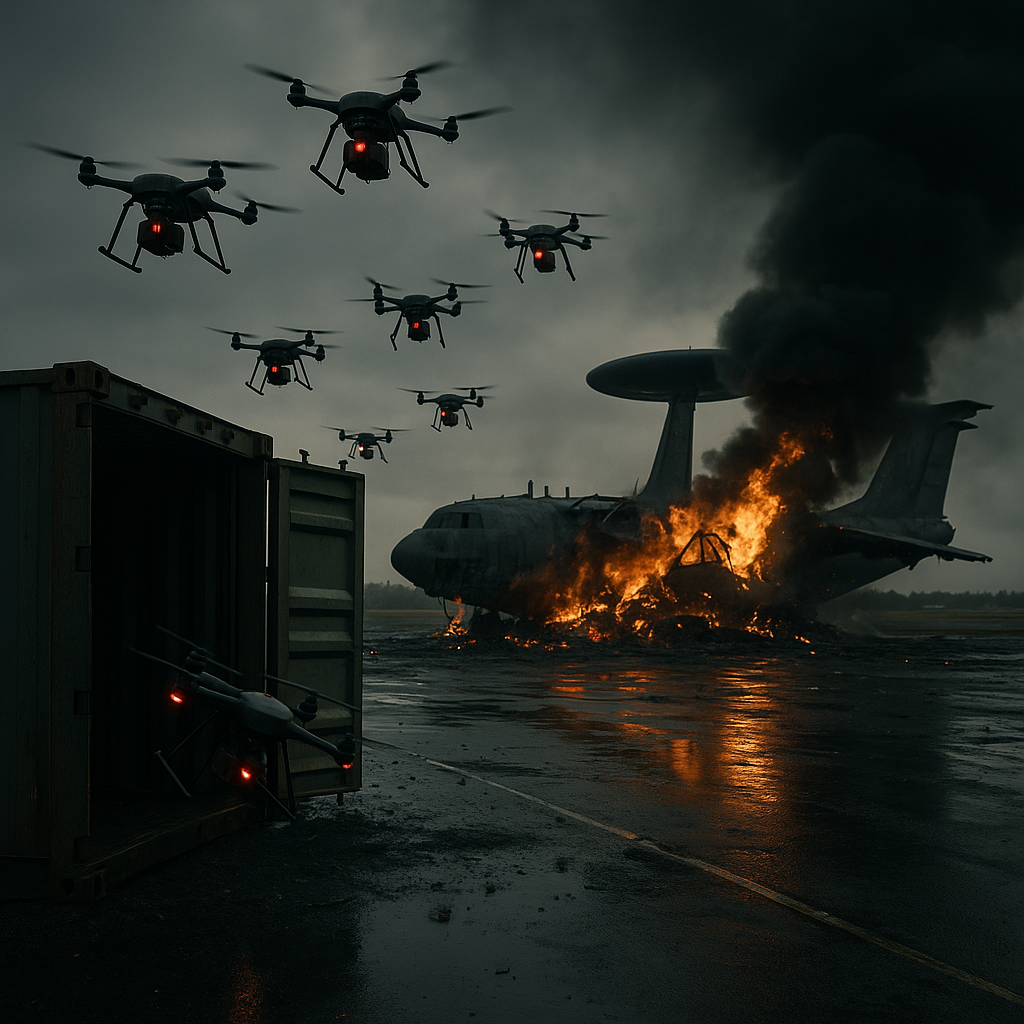
Ukraine Executes AI-Driven Drone Strikes on Russian Airbases
Operation Spiderweb saw Ukrainian forces launch autonomous drones against Russian targets, destroying 41 aircraft across four airbases. The drones reportedly continued targeting after signal loss.
Why it matters: This is the first confirmed use of AI-enabled autonomous weapons at scale in a contested theatre.
Doctrinal shift: Control theory meets battlefield reality. The assumption that autonomy must remain supervised has dissolved. Ukraine just operationalised “detached lethality” under fire.
UK Commits £2 Billion to AI-Enabled Drone Warfare
The UK announced a £2bn programme to build AI-powered drones capable of autonomous targeting and ISR, declaring an aim to make the British Army “ten times more lethal”.
Why it matters: This represents a definitive shift from augmentation to autonomy in UK force design.
Doctrinal shift: The British Army’s lethality is no longer dependent on human operator scale, but on sovereign logic execution at the tactical edge.
Russia Plans 2 Million FPV Drones and 30,000 Long-Range Systems
Russian intelligence plans revealed a massive drone production push for 2025, including 2 million FPV drones and thousands of decoy/long-range variants.
Why it matters: This is not a prototype economy, it is industrialised autonomy at scale, aimed at saturating and overwhelming NATO defences.
Doctrinal shift: Russian emphasis on quantity over cognition reflects a brute-force adaptation of saturation logic to the battlefield.
Meta and Anduril Launch AR-AI Headsets for U.S. Troops
Meta and Anduril are collaborating to deliver augmented reality combat headsets that turn individual soldiers into real-time intelligence nodes.
Why it matters: Soldiers are no longer just recipients of situational awareness, they are emitters. The platform is the person.
Doctrinal shift: This fuses physical presence with digital logic in real-time, challenging command hierarchies and centralised decision-making.
China Escalates AI Infrastructure Drive to Secure Global Lead
China is accelerating the construction of specialised AI data centres as part of a strategic campaign to become the world’s AI superpower.
Why it matters: This infrastructure push underpins not just economic dominance but military compute supremacy.
Doctrinal shift: China’s model is clear, dominance through architecture. The West still debates ethics while the PLA builds capacity.
Russia Leverages BRICS to Reduce AI Dependence on West
Russia is using BRICS partnerships to advance its AI programmes and reduce reliance on Western platforms, reportedly seeking joint development channels and compute independence.
Why it matters: This is techno-sovereignty in action, an effort to establish an Eastern logic layer distinct from NATO frameworks.
Doctrinal shift: Sanctions forced a doctrinal pivot: redundancy through alliance. Expect logic-sharing between Russia, China and India to increase.
UK Delays AI Regulation for Broader Control Bill
UK ministers delayed targeted AI regulation to develop a more comprehensive bill including safety, copyright and potentially model registration.
Why it matters: The UK is signalling a pivot from sector-specific controls to whole-of-society AI governance.
Doctrinal shift: Security regulation is moving upstream, from outcomes to architectures. AI safety is now a matter of national infrastructure.
UK Strategic Defence Review Centres on Runtime Autonomy
The latest UK Defence Review confirms plans for a £1bn AI targeting system and autonomous submarine fleet expansion.
Why it matters: This review marks runtime logic and platform independence as core principles of UK force projection.
Doctrinal shift: UK doctrine is quietly discarding platform-centric thinking. The logic, not the hull, is now sovereign.
SIGNALS IN THE NOISE
Detached, Distributed, Decisive
The decisive shift this week was not in headlines, but in architecture. We saw real combat systems, Ukrainian drones, British defence platforms, Meta-enabled soldiers, executing missions under runtime logic, not runtime command. “Operation Spiderweb” didn’t just strike aircraft; it shredded the doctrine that assumes autonomous systems must phone home before killing.
Meanwhile, both Russia and China revealed their preferred paths to logic dominance. China’s is infrastructural, AI superiority via control of compute. Russia’s is tactical, mass-saturation drones and BRICS-based logic collaboration. Both reject Western assumptions of centralised coordination and doctrine-by-committee.
The UK’s £2bn drone commitment and £1bn digital targeting system suggest that runtime logic is becoming the backbone of 21st-century lethality. These systems don’t just speed up OODA loops, they dissolve them, replacing cycles with conditions-based execution.
Doctrine no longer holds that the human is “in the loop.” The loop is now optional.
PREDICTION PROTOCOL
- Expect Distributed Targeting Protocols to Enter UK Trials by Q4 2025
Given the commitments in the Strategic Defence Review and drone programme funding, UK forces are likely to test distributed runtime targeting systems within the next quarter. The goal: autonomous kill chains that still meet IHL thresholds, without relying on uplinked C2. - PLA Will Formalise Edge Autonomy Within Division-Level Doctrines
China’s AI infrastructure surge suggests near-readiness for doctrine-level incorporation of autonomous ISR and kinetic platforms. Expect the 2025–26 PLA update cycle to codify autonomous swarm or sentinel roles at division scale, likely trialled in Western Theatre Command exercises.
BLACK BOX – THE HIDDEN SIGNAL
Victoria’s Secret Cyberattack Shuts Down Online Ops
At first glance, a lingerie brand’s cyber failure might seem irrelevant to national security. But this breach—a total takedown of operations—offers a clear warning: high-value, consumer-facing infrastructure is still absurdly vulnerable. A single ransomware strike halted a billion-dollar business.
In war, this is a blueprint for soft-kill sabotage. Think logistics firms, telecoms providers, payment processors. The Victoria’s Secret failure reminds us: even soft targets collapse when their logic layer is exposed.
REFLECTION – WHAT THIS MEANS FOR SURVIVABILITY
This week proved decisively that survivability is no longer just about platform ruggedness or sensor redundancy. It is about runtime sovereignty.
The new survivability question is: who owns the kill logic and can it persist under fire, off-grid and out of contact?
Autonomy is now operational. But survivability demands not just autonomy but resilience across compute, doctrine and operator trust. The battlespace is no longer just terrain but the execution substrate. Fail there and you fail everywhere.
In the end, it won’t be firepower that decides this. It’ll be logic resilience.
A FUNNY THING HAPPENED IN THE GREY ZONE…
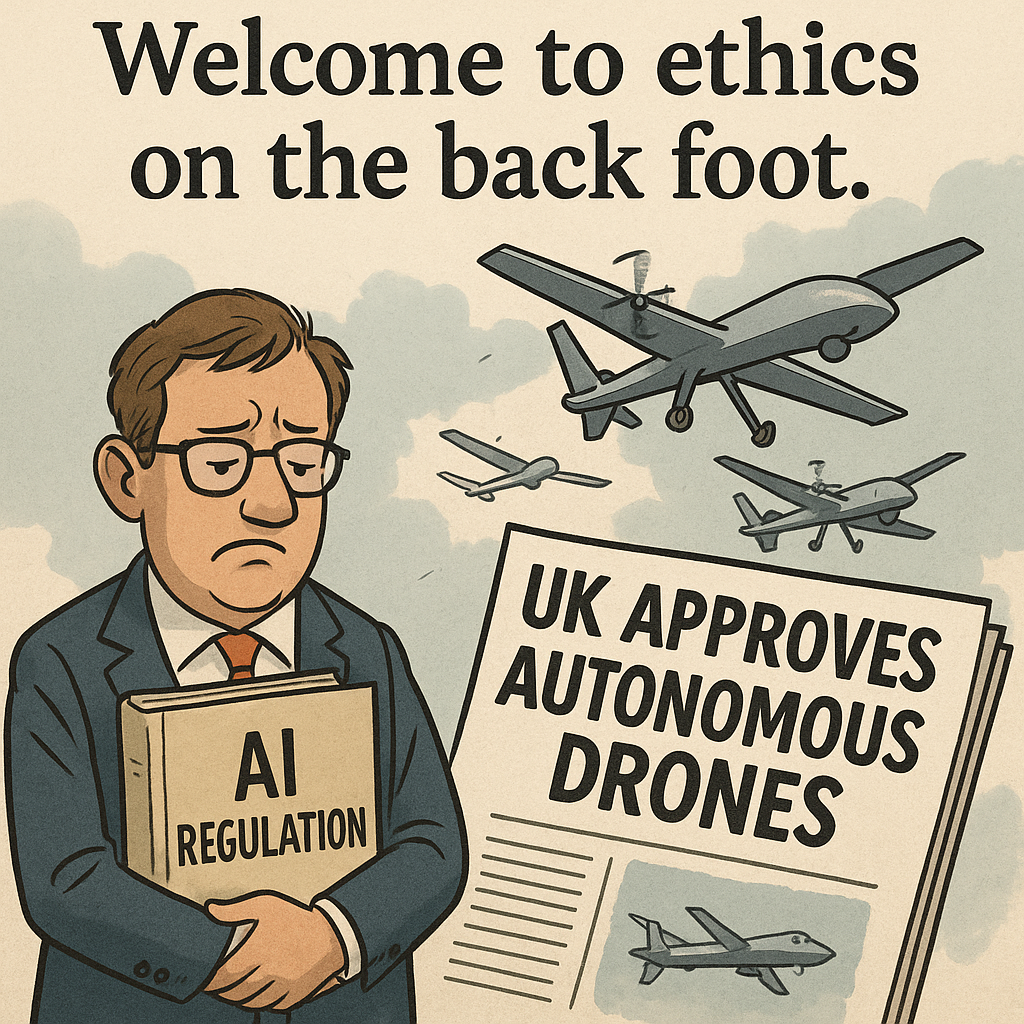
The UK delayed its AI regulation bill to write a more “comprehensive” one, while simultaneously approving a £2bn autonomous drone fleet. The irony? We’re building runtime autonomy faster than we can regulate runtime behaviour. Welcome to ethics on the back foot.
FOOTER
Quote of the Week
“No plan survives contact with the enemy. But logic now does.” – Paraphrased from Helmuth von Moltke (and updated for 2025)
Latest White Paper
CTA: Get this to someone who needs to see the terrain.
Dispatch Ends
#AIWarfare #CyberConflict #AutonomousWeapons #DigitalSovereignty #CyberEscalation #WarfareInnovation #NoHumanInTheLoop #AlgorithmicConflict #FutureOfWar #DualUseAI #GreyZoneWarfare #RuntimeWarfare #StrategicDrift #DefenceTech