
Ambient Stratagem: Dispatches from the Algorithmic Front - 6th July 2025
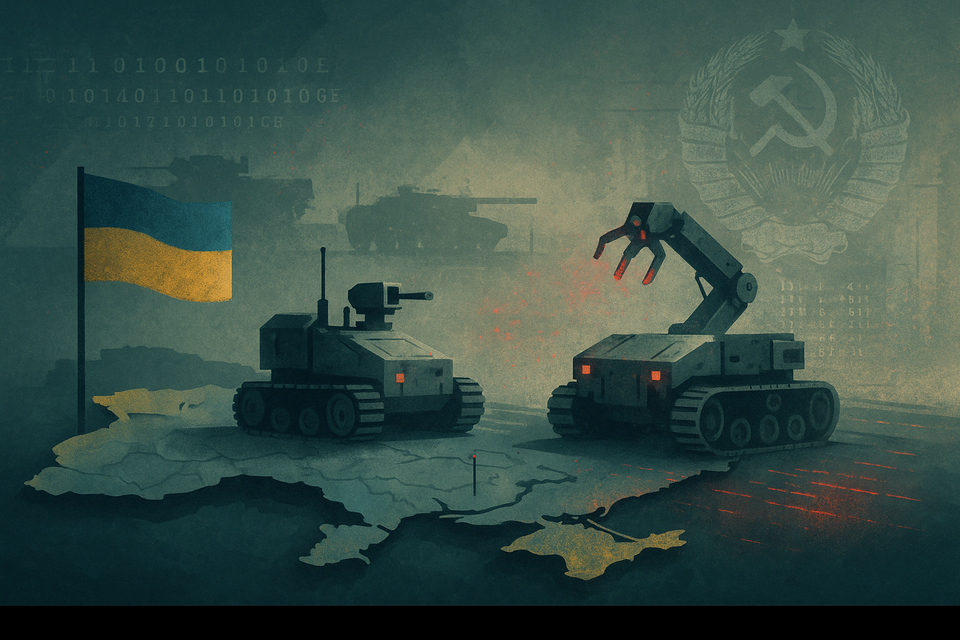
A curated, doctrinally relevant, operator-level briefing from the bleeding edge of machine-led conflict and ambient warfare.
🕐 ~5 min read
Week: 29 June – 5 July 2025
Entering the Logic Layer
When a warfighter in Donetsk can swap out drone modules like Lego bricks, we are no longer dealing in theoretical frameworks. This week’s battlespace reveals not only escalation, but something more profound: a collapse of the distinction between prototyping and deployment. Autonomy is no longer a roadmap, it’s a reality being wired into old hardware, field-upgraded by necessity, and silently altering our understanding of control.
1. THIS WEEK’S ALGORITHMIC FLASHPOINTS
Ukraine Deploys Modular “Lego” Ground Robots
Ukrainian forces are now field-assembling ground robots like the D-21 and THeMIS using modular payloads to enable ISR, logistics, or direct fire roles.
Why it matters: This innovation allows frontline forces to rapidly repurpose autonomous platforms without waiting for factory reconfiguration—effectively compressing the procurement-to-deployment loop to hours.
Doctrinal shift: Breaks the assumption that robotic systems are fixed-role platforms. Ukraine is treating autonomy like software: modular, field-adaptable, and disposable.
Source → Financial Times, 5 July 2025
Autonomous Drones Escalate Ukraine–Russia Conflict
Both sides have deployed AI-guided drones—Ukraine’s Gogol-M and Russia’s V2U, with autonomous targeting and lethal capability.
Why it matters: This marks a doctrinal inflection point. Lethal Autonomous Weapon Systems (LAWS) are no longer theoretical or experimental—they are engaging each other at scale.
Doctrinal shift: Reinforces that deterrence through ambiguity is fading. Once both sides field LAWS, a logic-layer arms race begins—not of hardware, but of algorithmic superiority.
[Source → The Guardian, 3 July 2025]
Legacy Machine Guns Integrated into AI-Guided Ground Bots
Ukraine has fitted the D-21-12 and Droid TW 12.7 with legacy .50 cal M2 machine guns, enabling AI-directed ground and air targeting.
Why it matters: This bypasses the long development cycles of custom weapons integration. The “Ma Deuce” becomes a cheap, brutal tool in the logic wars.
Doctrinal shift: Subverts the high-spec procurement model. What matters now is logic compatibility, not platform elegance.
[Source → Business Insider, 1 July 2025]
UK Government Orders Defence Pivot at Turing Institute
Technology Secretary Peter Kyle has ordered the Alan Turing Institute to reorient its strategic focus toward national security and sovereign AI, including possible leadership changes.
Why it matters: A subtle but seismic redirection of one of the UK’s foremost AI institutions toward defence work—embedding research into sovereign runtime layers.
Doctrinal shift: Ends the post-Enlightenment illusion that academic AI research can remain ideologically neutral. Sovereignty demands embedded logic infrastructure.
[Source → The Guardian, 4 July 2025]
Cyberattack Hits ICC During NATO Summit
A sophisticated cyberattack disrupted systems at the International Criminal Court during the NATO summit in The Hague. Attribution is pending.
Why it matters: Strategic legal institutions are now high-value targets in information warfare. The timing suggests deliberate narrative sabotage during a critical NATO event.
Doctrinal shift: Confirms that kinetic and legal legitimacy layers are being synchronously targeted. Lawfare is now digital.
[Source → Reuters / AP, 30 June 2025]
Ransomware Surge Hits Critical Civilian Infrastructure
Major ransomware incidents impacted Kettering Health, The North Face, and Optima Tax Relief, among others.
Why it matters: Civilian infrastructure continues to be a soft entry point for destabilising attacks. The intensity of June’s ransomware wave suggests increasing automation and campaign coordination.
Doctrinal shift: Cyber deterrence based on proportionality is not functioning. Automation has flattened the cost of repeat attacks to near zero.
[Source → The Record, 1–5 July 2025]
Booz Allen and Shield AI Join Forces on Autonomy for DoD
Shield AI and Booz Allen Hamilton announced a strategic partnership to accelerate integration of autonomous capabilities across DoD systems.
Why it matters: Commercial autonomy stacks are now being rapidly embedded into operational defence systems, bypassing slower government development tracks.
Doctrinal shift: Confirms the merger of advisory and autonomy roles. Integrators now carry not only logic infrastructure but influence over its operational doctrine.
[Source → Military Embedded, June 2025]
Lockheed’s Squad X Awards AI Autonomy Contract to BAE Systems
Under the Squad X program, BAE has been tasked to integrate AI into robotic small-unit platforms.
Why it matters: Embedding AI into squad-level operations redefines human-machine teaming, pushing decision logic deeper into the tactical stack.
Doctrinal shift: Validates a shift from command-centric to mission-distributed autonomy. Decision edges are moving outward.
[Source → Military Embedded, June 2025]
2. SIGNALS IN THE NOISE
This was the week autonomy left the lab and entered doctrine by default.
Across Ukraine, modular combat robots and autonomous drones aren’t being trialled, they’re being field-hacked into existence. The separation between “AI R&D” and “warfighting AI” has collapsed. The integration of century-old .50 calibre weapons with contemporary targeting AI crystallises the moment: lethality doesn’t require new metal, only executable logic.
Simultaneously, the UK’s decision to re-task its leading AI institute toward national security confirms what adversaries already understood, sovereign logic is the final terrain. This mirrors China’s long-standing integration of academic research with military doctrine and Russia’s preference for field testing in live zones.
The cyber domain saw the legal and civilian underbelly of NATO struck without fanfare. The ICC incident during a NATO summit is not coincidental; it’s hybrid deterrence by legal disruption. Ransomware attacks follow the same doctrine: bleed the civilian layer, trigger operational distraction, drive decision fatigue.
What is emerging is a distributed autonomy arms race, logics are being weaponised faster than institutions can agree on rules for their use. Procurement doctrine is being rewritten not by policymakers, but by engineers on the battlefield. The operator is now a compiler.
3. PREDICTION PROTOCOL
1. Expect NATO frontline units to deploy autonomy kits for modular retrofitting by Q4 2025.
Ukraine’s battlefield innovation is being watched closely. NATO special forces, particularly in Poland and the Baltics, are likely to adopt modular AI kits for ISR and direct-fire platforms, particularly in urban warfare scenarios.
2. Russia will escalate dual-domain disruption, combining LAWS deployment with legal warfare.
The ICC cyberattack is a doctrinal signal. We expect increased targeting of institutions that underpin NATO legitimacy: war crimes courts, human rights bodies, and command-legal interfaces.
4. BLACK BOX – THE HIDDEN SIGNAL
The .50 cal M2 is the new AI weapon system.
While the world debates drone swarms and LLM ethics, Ukraine just embedded one of the most iconic 20th-century weapons into a 21st-century autonomous platform. That single move, pairing a 1933 machine gun with onboard targeting AI, collapses the timeline of military innovation.
Why it matters: This is runtime war-fighting. Sovereignty no longer depends on high-end bespoke platforms, but on whether your logic layer can adapt legacy metal at speed.
5. REFLECTION – WHAT THIS MEANS FOR SURVIVABILITY
Survivability is no longer about armour or even concealment, it’s about logic fluidity. The ability to field-adapt your autonomous systems, to fuse old weapons with new targeting, and to shift doctrinal assumptions on the fly is the difference between irrelevance and resilience.
The Western model, based on centralised procurement cycles, high-spec design, and tight C2, cannot survive contact with runtime war. Survivability now demands compiler-grade modularity at the edge, autonomous fallback modes, and mission-specific configurability without connectivity.
In the end, it won’t be firepower that decides this.
It’ll be logic resilience.
6. A FUNNY THING HAPPENED IN THE GREY ZONE…
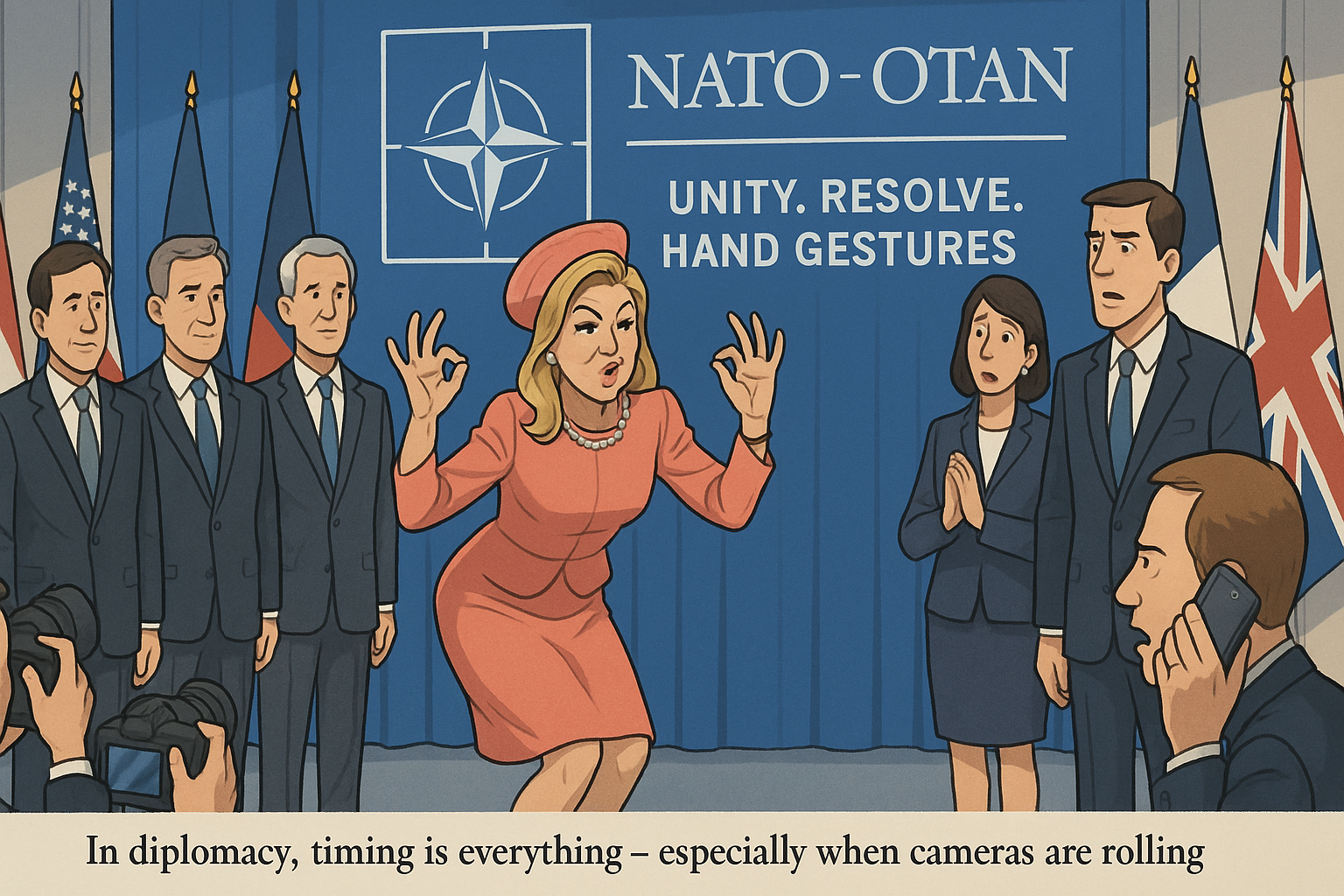
During the NATO summit in The Hague, Dutch Queen Máxima was caught on camera playfully imitating former U.S. President Donald Trump’s hand gestures while greeting delegates. The footage aired live before being lightly trimmed from official channels, though not before it circulated across diplomatic WhatsApp groups.
A reminder that in the theatre of statecraft, even royalty occasionally breaks the fourth wall.
[Source: Politico Europe, 4 July 2025]
FOOTER
Quote of the Week:
“In war, the most expensive weapon is the one that requires a consensus to fire.” – Field Doctrine Officer, Ukrainian 92nd Mechanised Brigade
Latest White Paper:
Redefining Insurable Risk in the Grey Zone
CTA:
Get this to someone who needs to see the terrain.
Dispatch Ends
#AIWarfare #CyberConflict #AutonomousWeapons #DigitalSovereignty #CyberEscalation #WarfareInnovation #NoHumanInTheLoop #AlgorithmicConflict #FutureOfWar #DualUseAI #GreyZoneWarfare #RuntimeWarfare #StrategicDrift #DefenceTech