
Ambient Stratagem: Dispatches from the Algorithmic Front - 29th June 2025
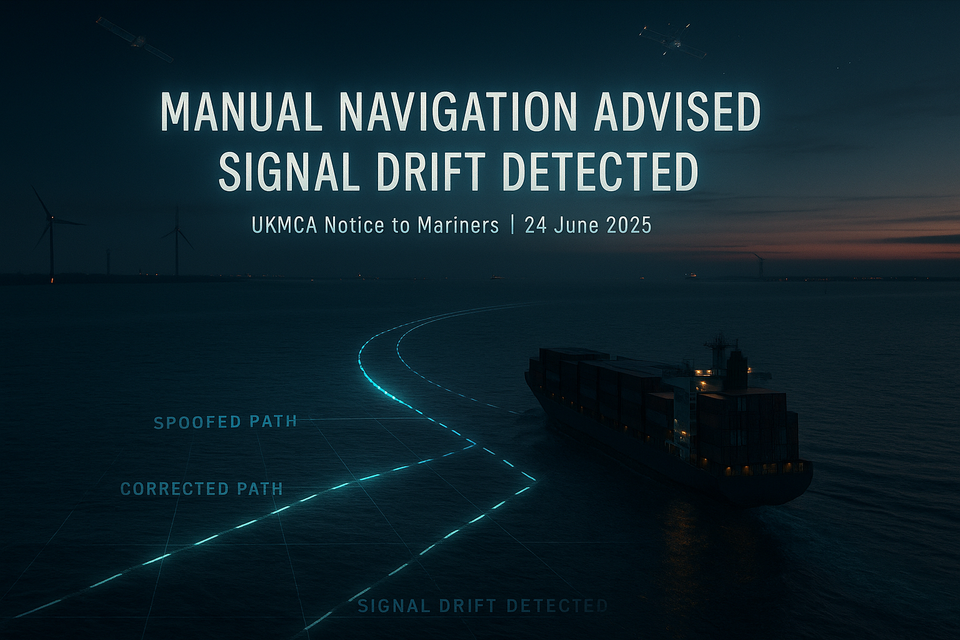
A curated briefing from the bleeding edge of machine-led conflict and ambient warfare
Week: 22–28 June 2025
Entering the Logic Layer
In the old model, threats escalated. Now they sustain. The distinction isn’t academic, it’s doctrinal. Adversaries are no longer probing thresholds to cross; they are refining the art of living beneath them. This week, from spoofed tankers to spoofed signals, from non-attributed cyber legacy cases to selective ceasefires, the Grey Zone matured. Not with a bang, but with a posture.
One might ask whether Clausewitz would recognise it as war. The insurance market certainly does, even if no one wants to call it that.
1. THIS WEEK’S ALGORITHMIC FLASHPOINTS
GPS Interference Triggers Maritime and Aviation Alerts Across the Baltics
EASA issued a formal warning after sustained GPS disruption across the Baltic Sea, affecting commercial flights and shipping. Lithuania publicly attributed the interference to Russian military activity, warning that jamming would likely continue even after the Ukraine conflict ends.
Why it matters: This was not a trial. It was full-spectrum environmental shaping, interfering with both air and sea domains over an extended period.
Doctrinal shift: Reflects deliberate Russian use of reflexive control, degrading confidence in Western geolocation infrastructure without visible provocation.
U.S. Conducts Limited Airstrikes on Iranian Nuclear Infrastructure
On 22 June, the United States launched targeted airstrikes on Iranian nuclear-related facilities, striking a hardened site believed to support advanced weapons development. No formal declaration of war followed.
Why it matters: The strike was strategic, not symbolic. It demonstrated capability against deeply buried assets, while remaining beneath the escalation threshold.
Doctrinal shift: This is calibrated deterrence through opacity, a live-fire signal that the logic layer of strategic containment now operates without overt commitments or congressional declarations.
Houthi Ceasefire Pauses U.S. Targeting, Persists Elsewhere
Houthi leadership announced a pause in attacks on U.S. vessels in the Red Sea, while continuing strikes on ships with Israeli and other regional affiliations.
Why it matters: A partial ceasefire is not peace. It’s a segmentation of hostility to divide legal and operational responses.
Doctrinal shift: Mirrors China’s Three Warfares doctrine, legal ambiguity, media manipulation, and selective threat calibration.
AIS Spoofing in Hormuz as Vessels Mimic Chinese Ownership
Commercial vessels in the Strait of Hormuz manipulated AIS signals to falsely appear as Chinese-flagged, aiming to reduce risk of targeting amid regional volatility.
Why it matters: This is metadata as body armour. The signal is the survivability tool.
Doctrinal shift: Indicates a battlefield logic shift: deception now begins in the packet stream, not the battlespace.
Frontline Halts Tanker Bookings in Strait of Hormuz
Shipping firm Frontline suspended all new contracts for transiting Hormuz, citing “persistent Grey Zone interference” without pointing to any specific attack.
Why it matters: Commercial action is now acting as proxy for national security posture.
Doctrinal shift: Underscores the rising role of insurance logic in national deterrence signalling — the underwriter becomes the early warning system.
Litigation Continues Over NotPetya and SolarWinds Attribution
U.S. courts are still adjudicating whether the NotPetya and SolarWinds attacks qualify as acts of war or insurable cyber events.
Why it matters: The ambiguity is not procedural, it’s systemic. Years on, we still cannot say definitively whether the incidents were ‘war’ or not.
Doctrinal shift: A clear indictment of exclusionary frameworks that rely on attribution in a world defined by its absence.
2. SIGNALS IN THE NOISE
What doctrine is breaking, and what’s replacing it?
This week’s flashpoints form a near-textbook study in the evolution of contested environments, not as isolated flare-ups, but as systems deliberately shaped by adversarial design. If a common thread runs through the events from the Red Sea to the Baltic to Iran, it is this: the shift from event-based escalation to persistent control over the logic layer of risk, attribution, and decision-making.
Let’s take them in sequence.
The U.S. strike on Iranian nuclear infrastructure marks a clear use of strategic kinetic force, yet without escalation. It was calibrated, limited, undeclared. And most importantly, it was aimed at infrastructure, not ideology. This is not the return of Cold War deterrence. It is something more brittle: strategic control through managed opacity. The strike succeeded in sending a message, but left no doctrinal clarity in its wake. That is precisely the point.
In parallel, the Houthi ceasefire, selectively applied only to U.S.-flagged vessels, illustrates how non-state actors can exploit legal ambiguity to fracture alliance cohesion. By removing the U.S. from their declared target list, they transform the remaining attacks into a grey area, legally plausible, diplomatically deniable, commercially consequential. This isn’t chaos. It’s design. A deliberately segmented threat posture intended to erode unified deterrence.
Meanwhile, in the Strait of Hormuz, tankers are no longer relying on naval escorts or insurer backstops. They’re changing their metadata, falsifying AIS signals to impersonate Chinese ownership. This is not just an act of deception; it’s a reconfiguration of survivability logic. The signal becomes the shield. Commercial actors are adapting faster than states, because they cannot afford to wait.
The same logic plays out in the Baltics, where GPS interference has transitioned from nuisance to systemic threat. When the European Union Aviation Safety Agency (EASA) issues a cross-domain alert, and Lithuania openly states that Russian jamming will persist even after the Ukraine war, we are no longer in the realm of “electronic warfare during wartime.” We are looking at permanent degradation as strategy.
And then there is Frontline, quietly stepping back from Hormuz, not because of a specific threat, but because of the accumulation of uncertainty. This decision, made without a missile fired or a mine detected, reveals the new fault line: confidence erosion as strategic effect.
All of this is underwritten by a deeper structural problem. The continued legal disputes over NotPetya and SolarWinds show just how ill-equipped our risk frameworks are to deal with attacks that live in limbo — between state and proxy, between war and crime. Courts still cannot agree on what these events were, let alone how to insure against the next one.
So what doctrine no longer holds?
- That escalation is visible, kinetic, and attributable.
- That national actors hold a monopoly on shaping strategic environments.
- That insurance and underwriting logic can rely on clear thresholds.
What replaces it is more diffuse, but more instructive:
- Opacity as deterrence.
- Metadata as survivability.
- Confidence erosion as effect.
- Persistent Hostile Activity (PHA) as the new strategic substrate.
States no longer need to destroy infrastructure to win. They need only make it uninsurable. That is the logic adversaries are beginning to exploit. And until Western doctrine adapts to account for that shift, in procurement, underwriting, command structures, and legal definitions, the initiative will continue to drift.
3. PREDICTION PROTOCOL
Grounded forecasts based on doctrine, tactical pattern and technological feasibility.
Prediction 1: Expect regional shipping insurers to quietly introduce corridor-based parametric exclusions in the Strait of Hormuz by Q3 2025.
The Frontline withdrawal and spoofing tactics used by commercial vessels signal a clear decoupling between ground truth and coverage logic. Underwriters can no longer wait for formal attribution or missile impacts to reprice risk. The likely response will be quiet, technical, and geospatial: parametric clauses linked to activity thresholds (e.g., confirmed spoofing incidents, threat advisories, or naval alert levels) that automatically suspend cover or trigger sub-limits.
This is consistent with post-NotPetya clause evolution, and it allows insurers to price ambiguity without declaring hostility. It will also become a model for underwriting in other contested zones, the Red Sea, Baltic, and eventually, Northern Australia.
Prediction 2: The next iteration of U.S. strategic airstrikes will include machine-learning-assisted target prioritisation, but will not be labelled as autonomous.
The Iran strikes demonstrated calibrated logic, prioritisation, not decapitation. It is increasingly likely that machine-speed analysis played a role in shaping strike packages, perhaps through pattern-of-life modelling or hardened-site viability scoring. As with ISR applications in Ukraine, the term “autonomy” will be avoided, but the functionality will match or exceed doctrinal definitions.
The military legal community will remain behind the curve, focusing on command intent rather than capability stacking. Meanwhile, adversaries will observe and learn, adapting with greater frequency modulation in infrastructure deployment.
4. BLACK BOX: THE HIDDEN SIGNAL
A story that changed everything, if you knew where to look.
Buried in a Maritime Safety Directive: The UK’s Admission of Sub-Threshold Navigation Warfare
On 24 June 2025, a routine update to the UK Maritime and Coastguard Agency’s Notice to Mariners included an understated clause: “Operators are advised that persistent GNSS interference in the North Sea and Baltic is consistent with strategic state-aligned activity. Rerouting or manual navigation protocols may be required.”
That phrase “strategic state-aligned activity” may not have made headlines. But its significance is profound.
This is the first time the UK has publicly and institutionally acknowledged that commercial navigational degradation in its near waters is not accidental, not collateral, and not cybercrime. It is warfare by other means. And it has now been absorbed into the official operating picture.
Why does it matter?
- It confirms what Baltic actors like Lithuania have said more explicitly: GPS interference is not episodic. It is strategic.
- It subtly shifts the legal risk profile for insurers and shipping operators — as rerouting becomes standard, so too do delays, costs, and claims.
- It forces alignment between security, insurance, and commercial stakeholders, even without formal NATO invocation or overt threat classification.
This was not a policy speech. It was a buried clause. But it closes the attribution loop more clearly than any cyber doctrine ever has. From here on, anyone ignoring ambient navigational warfare as a strategic condition, rather than a technical glitch, is not merely behind the curve. They are exposed.
5. REFLECTION: WHAT THIS MEANS FOR SURVIVABILITY
Strategic clarity on what’s shifting beneath our feet.
The logic of survivability has long depended on two assumptions: that threats will escalate in ways we can track, and that responses can be triggered once a threshold is crossed. This week’s events dismantle both.
The strike on Iran’s nuclear infrastructure showed how kinetic force can be used not to provoke, but to shape, conducted in silence, it aimed to freeze momentum, not ignite it. The adversarial lesson here is subtle: you don’t need escalation to control narrative and tempo. That logic now informs not just war planning, but insurance behaviour and market posture.
Meanwhile, in the maritime domain, spoofing is no longer a threat. It’s a tactic, pre-emptive, systemic, and integrated into the operating playbook of both state and non-state actors. When vessels falsify ownership metadata to signal neutrality, and shipping giants quietly suspend operations absent a single shot fired, we are witnessing a new doctrine of survivability based on signal deception and corridor retreat.
This is survivability by obscurity. By staying beneath notice. By eroding confidence until operational continuity becomes a private, improvised act, not a shared national objective.
The risk is not that firepower overwhelms us. It is that the logic infrastructure collapses quietly, long before the first conventional threshold is breached.
When even commercial maritime notices start to echo adversarial doctrine, when “strategic state-aligned interference” becomes the new operational baseline, the question isn’t whether the conflict has started. It’s whether we’re still organised to detect it.
6. A FUNNY THING HAPPENED IN THE GREY ZONE…
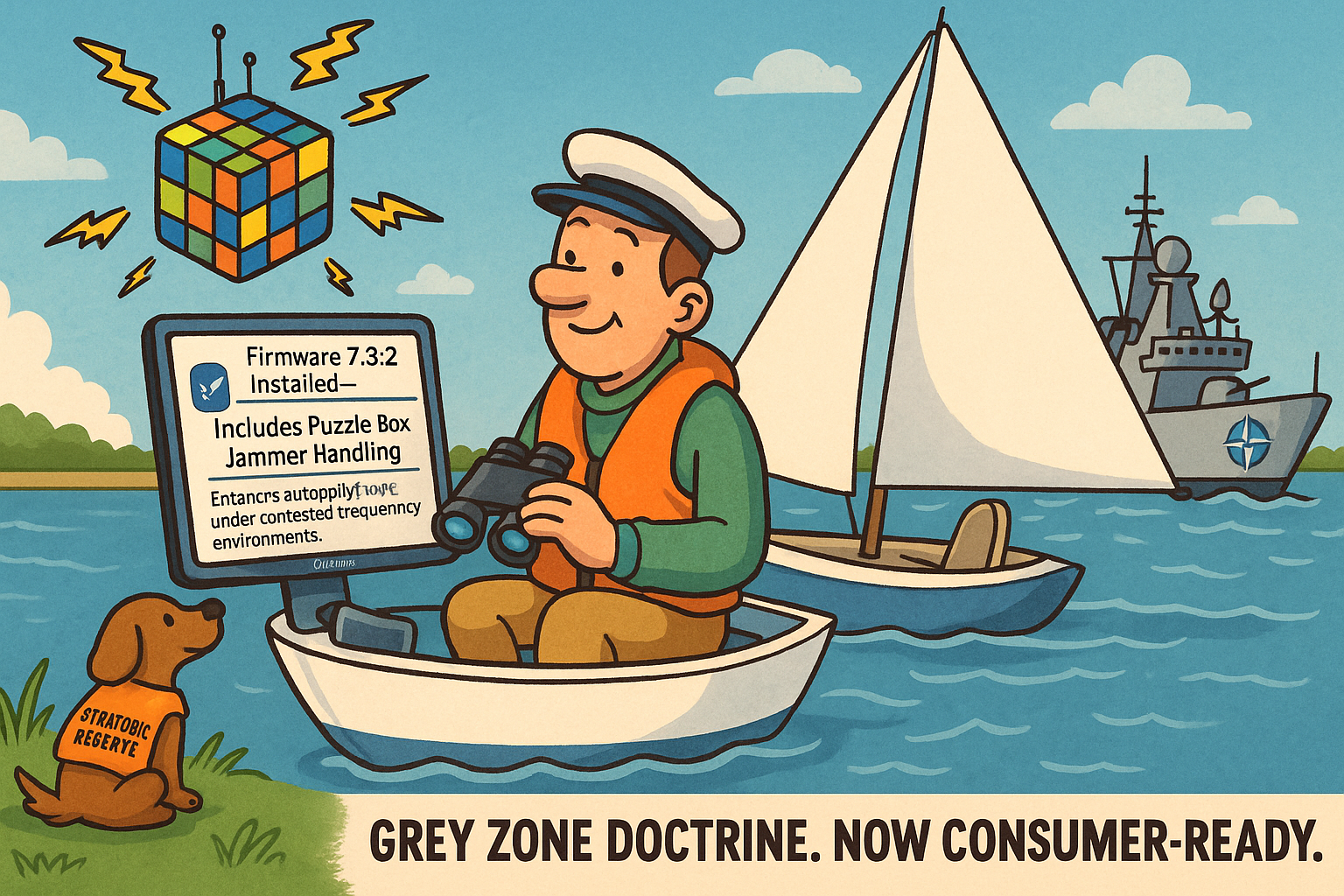
A true strategic absurdity.
Maritime Safety Directive References “Puzzle-Box” GNSS Interference, Not Officially Recognised as Warfare
This week, manufacturers of high-end yachts reported receiving a technical bulletin from Garmin (via UK marine distributors) stating: “Persistent GNSS interference observed in North Sea…frequency hopping frequency scrambling resembling a ‘puzzle‑box’ jammer pattern common to state-developed systems.” The surprising element: this notification was not flagged as a military risk, cyber alert, or navigational advisory, but was packaged in consumer-grade firmware update notes, alongside autopilot enhancements and chart corrections.
Why it’s telling:
- The motif of a “puzzle-box jammer” — a term lifted straight from classified EW manuals — has now entered the firmware of civilian maritime electronics.
- It signals that state-developed jamming techniques are being reverse-engineered into commercial navigation toolchains.
- The asymmetry is stark: what remains unspoken at the geopolitical level is quietly written into the update notes of user-facing maritime software.
Absurdity with impact: In the civilian user manual, a recreational sailor now sees echoes of the very doctrine shaping NATO’s strategic response — yet thinks it’s just a “new firmware feature.” Perhaps in a few years, hobbyists with a 12‑inch yacht will be rewriting fetch‑data while dancing around logic-layer warfare.
Quote of the Week:
“In logic warfare, the signal you never see is often the one that disrupts most.”
Latest White Paper:
“Redefining Insurable Risk in the Grey Zone” — published this week.
CTA:
Get this to someone who needs to see the terrain.
Dispatch Ends
#AIWarfare #CyberConflict #AutonomousWeapons #DigitalSovereignty #CyberEscalation #WarfareInnovation #NoHumanInTheLoop #AlgorithmicConflict #FutureOfWar #DualUseAI #GreyZoneWarfare #RuntimeWarfare #StrategicDrift #DefenceTech